ISO 14310 & API 11D1 Validation Grades: V6 to V0 Explained
Published:
Many engineers assume a higher V-number means a tougher packer. It is the opposite. Under ISO 14310 packer validation grades, the scale runs from V6, the minimum, down to V0, the most demanding gas-tight grade — so a lower number means more severe testing, not less. For anyone just trying to understand the basics, that inversion is where most confusion starts.
Many engineers assume a higher V-number means a tougher packer. It is the opposite. Under ISO 14310 packer validation grades, the scale runs from V6, the minimum, down to V0, the most demanding gas-tight grade — so a lower number means more severe testing, not less. For anyone just trying to understand the basics, that inversion is where most confusion starts.
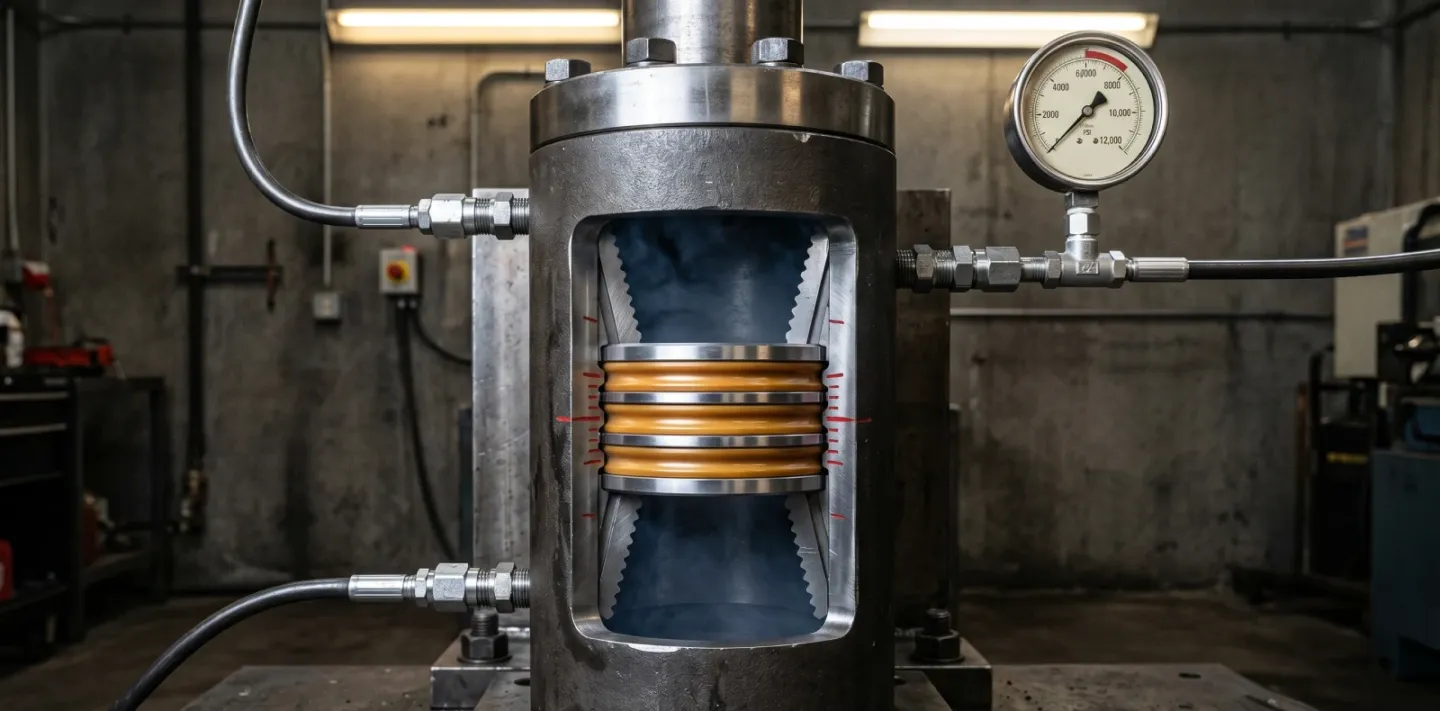
ISO 14310 and its API equivalent, API Specification 11D1, define how packers and bridge plugs are validated. The current 2008 edition specifies seven design-validation grades from V6, the minimum supplier-defined level, to V0, the most demanding grade requiring a bubble-tight gas seal. A lower grade number means more severe testing, not less.
ISO 14310 vs API 11D1: The Standards Behind the Grades
ISO 14310 is the international standard for downhole packers and bridge plugs, covering selection, design, validation, and testing. API Specification 11D1 / API Q1 is the API national adoption of that same standard (ANSI/API 11D1, ISO 14310:2008 modified), which is why the two are functionally equivalent.
The current edition is ISO 14310 :2008, which supersedes the 2001 version. Both establish a minimum parameter set a manufacturer must meet to claim conformity, structured as tiered rankings for two separate things: quality control and design validation.
If you need to explain this to non-technical stakeholders, the framing is simple: these standards turn a vague claim like "high-quality packer" into a specific, testable grade that any operator can verify. One important accuracy note — the 2001 edition listed six grades (V6 to V1) plus a special V0, while the current 2008 edition folds V0 into a single seven-grade scale from V6 to V0.
Design Validation Grades: V6 to V0
Under ISO 14310:2008, design-validation grade V6 is the minimum, with the manufacturer defining the method. Testing severity increases as the number decreases: grades V5 through V1 add liquid pressure, axial loads, and temperature cycling. V0 carries the same parameters as V1 but permits zero gas leakage, the highest seal-integrity classification.
Across every grade, the test baseline is the same: the packer is set in its maximum rated casing inner diameter at the maximum recommended operating temperature, with the minimum packoff force or pressure the manufacturer specifies. What changes between grades is how much is then demanded of it.
V6 is the floor — a manufacturer-defined validation for products that do not meet the V0 to V5 criteria. From V5 through V1, the standard progressively adds liquid pressure to maximum differential, axial loads in tension and compression, and temperature cycling. V1 is the highest grade tested with liquid; V0 then applies the same parameters but switches the test medium to gas and demands zero leakage.
| Grade | Test medium | Axial loads | Temp cycling | Seal criterion |
| V6 | Manufacturer-defined | Manufacturer-defined | Manufacturer-defined | Minimum; method set by manufacturer |
| V5–V2 | Liquid | Added progressively | Added progressively | Liquid pressure hold |
| V1 | Liquid | Tension + compression | Yes | Highest liquid-tested grade |
| V0 | Gas (nitrogen) | Tension + compression | Yes | Zero gas leakage (bubble-tight) |
Quality Control Grades: Q3 to Q1
ISO 14310 and API 11D1 grade equipment on two independent axes. Design-validation grades (V6 to V0) describe how rigorously a design was tested. Quality-control grades (Q3 to Q1) describe the manufacturing inspection level, with Q3 the minimum and Q1 the highest. A product carries one grade from each axis.
The Q-axis is the one most spec sheets gloss over. Q3 is the minimum, reflecting industry-minimum inspection practice. Q2 increases the requirement and allows sampling to verify conformance. Q1 is the highest, with the most thorough inspection and manufacturing verification.
Because the two axes are independent, a product is described by both — for example, V0/Q1 means a gas-tight design validation paired with the highest quality-control level. Under API 11D1, design verification itself draws on design reviews, calculations, comparison with similar proven designs, and historical operating records, with results approved by a qualified person and retained in the design documentation.
How V0 Testing Works
V0 validation tests a packer set in its maximum-rated casing inner diameter at maximum rated temperature, using gas — typically nitrogen — as the test medium rather than liquid. The packer must hold differential pressure through reversals and temperature cycles with zero gas bubbles observed during the hold period to pass.
The defining feature of V0 is the test medium. Where V1 and lower grades use liquid — water or hydraulic oil — V0 uses gas, typically nitrogen, because gas finds leak paths that liquid does not. That single change is what separates a gas-tight packer from a merely liquid-tight one.
The sequence is demanding. The packer is set in its maximum-rated casing inner diameter at maximum rated temperature, then taken to maximum differential pressure and subjected to pressure reversals and temperature cycles. To pass, zero gas bubbles may be observed during the pressure-hold period — the bubble-tight criterion.
This matters most in high-stakes service. HPHT is defined roughly at 15,000 to 20,000 PSI and 350 to 450 deg F, with ultra-HPHT above those thresholds. V0 qualification has been demonstrated into ultra-HPHT territory — technical papers indexed on SPE / OnePetro document V0 packers qualified to conditions such as 470 deg F and 20,000 PSI.
Need expert guidance on the right solution?
Talk to our engineers about your project requirements.
Why It Matters — The Maximus OIGA Perspective
Understanding the grade system is one thing; verifying a vendor's claim is another. As an ISO 14310 certified Maximus OIGA manufacturer— also holding API Q1, ISO 9001, API 11D1, 19LH, 19AC, 5CT, and 14L — Maximus OIGA tests its completion hardware against exactly these grades and documents the results.
The differentiator is transparency. Maximus OIGA validates completion hardware in an in-house facility rated to 500 deg F and 15,000 PSI with real-time sensor monitoring, and supplies published test data alongside material test reports and inspection and test certificates with every shipment. The aim is to let an engineer confirm a V0 or V3 claim against documented evidence, not a logo.
Common Misconceptions
Myth: V6 is the best grade. V6 is the minimum; V0 is the most demanding. Lower number, more severe testing — the scale is inverted relative to intuition.
Myth: V-grade and Q-grade are the same thing. The V-grades describe design validation (how rigorously the design was tested); the Q-grades describe quality control (the manufacturing inspection level). They are independent axes, and a product carries one of each.
Myth: V0 just means a higher-pressure water test. V0's defining feature is a gas — nitrogen — bubble-tight test, not liquid. And a final myth, that ISO 14310 and API 11D1 are different standards: API 11D1 is the API national adoption of ISO 14310:2008, so they are equivalent.
Frequently Asked Questions
What is the difference between ISO 14310 and API 11D1?
ISO 14310 is the international standard for packers and bridge plugs, and API 11D1 is API's national adoption of it (ANSI/API 11D1, ISO 14310:2008 modified). They are functionally equivalent, sharing the same design-validation grade system (V6 to V0) and quality-control grades (Q3 to Q1). API 11D1 is the version most often cited in API-monogram and US or operator procurement contexts, and a V0 claim under one is recognized under the other.
What is the V0 rating for packers?
V0 is the most demanding design-validation grade under ISO 14310 and API 11D1. It requires a bubble-tight gas seal, tested with nitrogen rather than liquid, with zero gas leakage allowed during the pressure-hold period. It uses the same load and temperature parameters as V1 but adds the zero-gas-leak acceptance criterion, which is why it is specified where gas-tight integrity is critical, such as gas wells and HPHT applications.
Is V0 the highest or lowest validation grade?
V0 is the highest, most demanding grade; V6 is the lowest, a supplier-defined minimum. The scale runs from V6 down to V0, and testing severity increases as the number decreases. A common misconception is that a higher number means a tougher grade — it is the reverse. The current 2008 edition lists seven grades from V6 to V0.
What is the difference between V grades and Q grades?
V grades (V6 to V0) describe design validation — how rigorously the design was tested. Q grades (Q3 to Q1) describe quality control — the manufacturing inspection and verification level. The two are independent, so a product carries one grade from each axis, such as V0/Q1. Q3 is the minimum quality grade and Q1 is the highest.
Next Steps
Knowing what V0 and Q1 mean lets you read a spec sheet with confidence and hold a supplier to documented evidence. Maximus OIGA tests its completion hardware to these grades and publishes the data behind its claims. Explore the full Maximus OIGA manufacturer range and request the test records to verify for yourself.
Related Blogs

More Information
Related News & Insights
Best bridge plug manufacturers in Asia
Thirteen bridge plug manufacturers in Asia — China, India and the UAE — compared on seven points, across drillable, retrievable, composite and dissolvable plug types.
October 20, 2026
Best downhole tool manufacturers in Asia
Fourteen downhole tool makers in Asia — China, India, Indonesia and the UAE — compared on seven points and on which of the six completion-tool families each one builds.
October 20, 2026
API 11D1 vs ISO 14310 - what a V0 rating actually certifies
What a V0 rating really means under API 11D1 and ISO 14310 — and ten checks that take a packer or bridge plug claim from the brochure line to the validation record behind it.
October 20, 2026
Indian downhole completion tool manufacturers compared: API status, plants, catalogue and lead times
Most Indian suppliers list packers, bridge plugs and liner hangers. The harder question is who actually makes the goods, where, and what documents arrive with the order. This comparison puts six Indian downhole tool manufacturers side by side on manufacture, plant location, catalogue breadth, published lead times and the documentation pack, using only what each company publishes about itself.
September 25, 2026
Zonal isolation systems
A bridge plug, a packer, a cement retainer, a straddle packer or a stage cementing collar can each be the right way to isolate an interval in a cased well. Which one depends on where the zone sits, how long the isolation must hold, and whether cement goes through the tool. This guide maps each isolation job to its tool class and its named SpectraMax models, then covers what to specify, how each tool sets and seals, and where each option stops working. It also sets out the records that ship with the order and the lead-time bands by product class, so you can plan the run before the quotation arrives.
September 25, 2026
Casing scrapers
A packer, bridge plug or cement retainer only grips and seals on a clean casing wall, and the scraper that cleans it has to fit your casing on the way down and at depth. This guide covers how a casing scraper cleans, the three main configurations, and how to size one to your casing OD and weight range, with worked ID and drift figures for 5-1/2 in, 7 in and 9-5/8 in casing. It then matches each configuration to its well condition, sets out where every option stops working, and lists the records that should ship with the order.
September 25, 2026

Gas anchors
Low fillage, fluid pound or a gas-locked rod pump usually points to the same tool below the pump: a gas anchor. Which configuration fits depends on whether the pump can sit below the perforations, how much liquid it displaces, and whether solids or deviation are in play. This guide works through the four configurations by well condition, then covers the sizing rule, the specifications a quotation has to fix, and where each option stops working. It also sets out the records that should ship with the part and the SpectraMax lead-time bands by product class.
September 25, 2026
Coiled tubing tools
"Coiled tubing tools" covers three different things: the surface spread, the intervention bottom-hole assembly, and the completion tools coiled tubing conveys and sets. Only the third group is manufactured completion equipment, and it is the group this page is about. It covers what conveyance changes about the tool itself, which of the three families (bridge plug, cement retainer, packer) suits which job, and the six inputs a supplier needs to quote one. It also sets out where each option stops, the records to ask any supplier for, and the lead-time bands by product class.
September 21, 2026
Saudi Aramco vendor registration for completion equipment suppliers
Saudi Aramco vendor registration is a prequalification on Aramco's e-Marketplace that ends in a Vendor ID, and being registered is not the same as being qualified. This guide walks the out-of-Kingdom route for a completion equipment manufacturer: how Aramco weighs financial strength, technical qualification and IKTVA local content, and which documents an international supplier actually files instead of the Saudi statutory set. It also sets out what a manufacturer can carry for your submission, what stays with you, and the records to ask any supplier for before a purchase order.
September 21, 2026
ONGC vendor registration for downhole tool suppliers: the actual sequence
Selling downhole tools to ONGC starts with a commercial gate, not the technical bid: you complete supplier self-registration on ONGC e-Procurement, get a bidder User-ID, then finish vendor enlistment before you can bid on a single tender. This guide walks the actual sequence, the documents an Indian or overseas applicant submits, how ONGC weighs a bid once local content is applied, and a realistic timeline. It is honest about what a manufacturer can and cannot do for your bid, and what to ask any supplier for in writing.
September 21, 2026