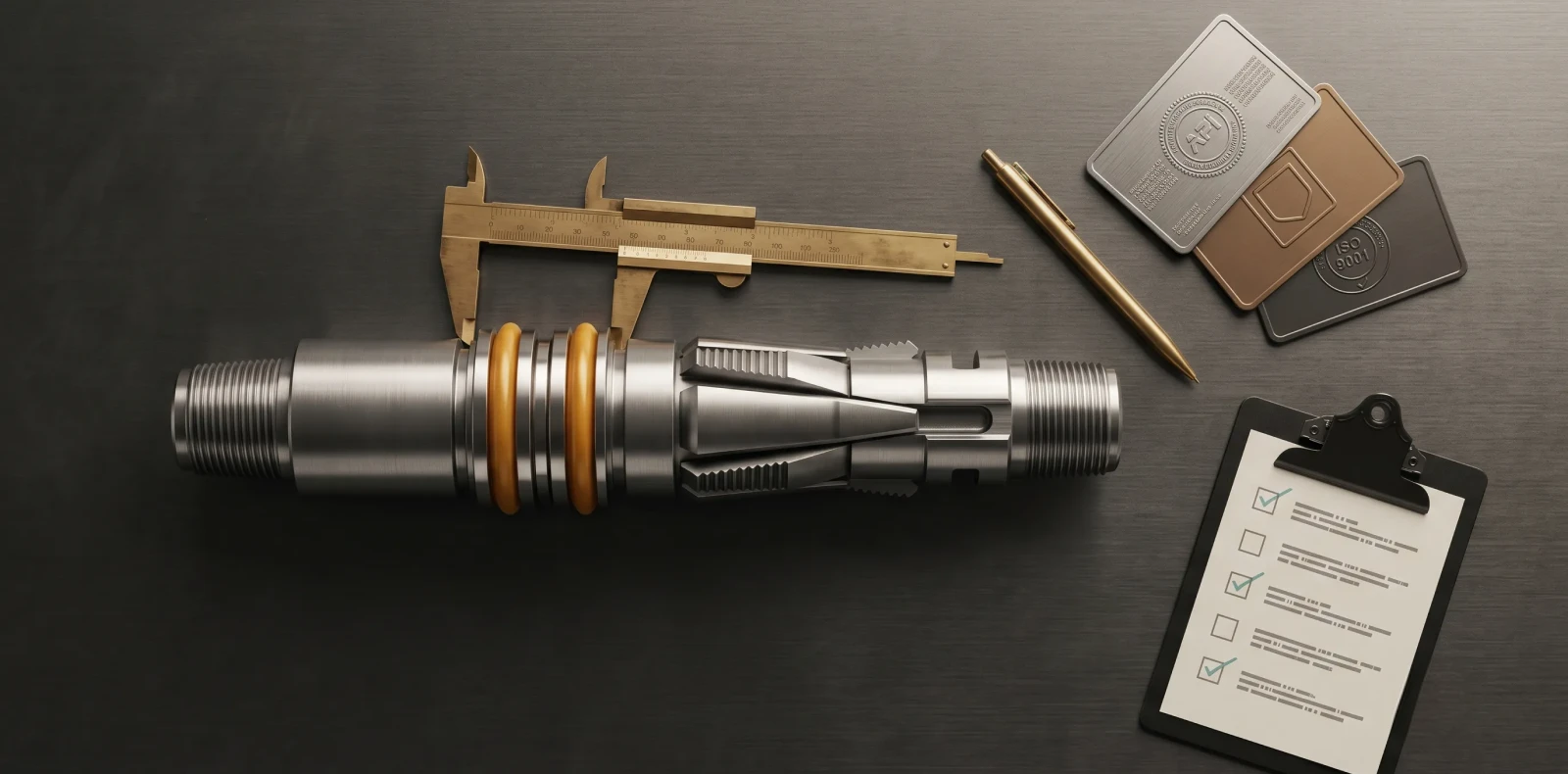
How to Choose an Oilfield Equipment Supplier A Procurement Guide
Published:
Choosing the wrong oilfield equipment supplier does not just waste procurement budget; it risks downhole failures that cost ten times the equipment price. Knowing how to choose an oilfield equipment supplier means looking past the catalog and the quotation to the evidence that a vendor can actually deliver safety-critical completion equipment. Procurement engineers who get this right treat the decision as risk management, not purchasing
Choosing the wrong oilfield equipment supplier does not just waste procurement budget; it risks downhole failures that cost ten times the equipment price. Knowing how to choose an oilfield equipment supplier means looking past the catalog and the quotation to the evidence that a vendor can actually deliver safety-critical completion equipment. Procurement engineers who get this right treat the decision as risk management, not purchasing.
This guide is the technical reference engineers ask for when they need a trusted basis for vendor evaluation, not a sales brochure. It lays out the selection criteria, the certifications worth verifying, and the source-type distinctions that separate a defensible decision from a costly one.
Why Supplier Choice Matters
Equipment procurement is a major share of project spend, and in well completion the consequences of a poor choice are measured in production downtime, not just purchase price. A failed packer or bridge plug at depth stops production and drives intervention costs far above what the tool itself cost. Quality therefore has to be built in at design and procurement, not caught at end-of-line inspection - and the supplier decision is where that quality is secured or compromised.
Core Selection Criteria for Equipment Supplier Evaluation
A structured evaluation beats a gut-feel vendor choice. Formal supplier-evaluation methods range from categorical scoring to weighted-point and dimensional analysis; the six criteria below give procurement engineers a defensible framework rather than a generic checklist.
Vendor experience with major operators signals reliability, and local spare-parts availability directly reduces downtime when a workover cannot wait. Weight the safety-critical criteria - certifications and documentation - above commercial factors like price.
| Criterion | Why it matters | What to request / verify |
|---|---|---|
| Certifications matched to product | A general QMS does not certify a specific tool | Valid API Q1 + product Monogram for the exact category |
| Field track record | Proven performance in comparable well conditions | Installation references in matching environments |
| Testing capability | Validation prevents downhole surprises | In-house or witnessed FAT; test protocols |
| Traceability + documentation | Chain-of-custody for safety-critical parts | MTR/CMTR and inspection reports per shipment |
| Technical support | Engineering review reduces specification error | Access to application engineering, not just sales |
| Lead time + spares | Availability protects production schedule | Realistic delivery and spare-parts stock |
Certifications and Documentation in API Certified Supplier Selection
API Q1 is a quality management standard built for oil and gas manufacturers. It meets most ISO 9001 requirements and adds industry-specific controls such as stronger traceability, contingency planning, management of change, and supplier qualification. ISO 9001 is the broader, all-industry foundation beneath it.
The API Monogram is a separate, voluntary product license. It allows a manufacturer to mark equipment that meets a specific API specification, and it requires a Q1-compliant quality system plus an initial on-site audit and annual audits by API. Monograms relevant to completion equipment include API 11D1 (packers and bridge plugs), API 14L (liner hangers), and API 5CT (casing and tubing).
ISO 14310 is distinct again: it sets validation grades for packers and bridge plugs, with V0 the highest grade, denoting zero gas leak. A supplier holding ISO 14310 has demonstrated sealing performance an ISO 9001 certificate alone says nothing about.
There is a practical difference between “compliant” and “certified.” Certified means API auditors physically verified the system or product. Always request the valid certificate and confirm it is current on the official API Composite List, and review what each credential actually certifies through the API Q1 / Monogram program.
Documentation is where evaluations are usually won or lost. A material test report (MTR or CMTR) proves grade, composition, and heat number; verify that the heat or lot traces cleanly from the MTR to the markings on the delivered part with no gaps. Red flags include mismatched heat numbers, missing fields, and reissued or inconsistent documents.
Maximus OIGA holds API Q1, ISO 14310 for packer systems, and ISO 9001, and supplies documentation - MTRs, inspection reports, and test certificates - with every shipment, which is the level of traceability procurement engineers need for evaluation.
| Credential | Scope | What it certifies | Why it matters |
|---|---|---|---|
| API Q1 | Oil & gas QMS | Manufacturer quality system + industry controls | Baseline for safety-critical supply |
| ISO 9001 | All-industry QMS | General quality management | Foundational, not industry-specific |
| ISO 14310 | Packer / bridge-plug validation | Sealing grade (V0 = zero gas leak) | Proves sealing performance |
| API Monogram | Specific product (11D1 / 14L / 5CT) | The product meets a named API spec | Certifies the tool, not just the system |
Manufacturer vs Distributor vs Trader
Source type matters as much as the specification in oilfield equipment procurement. A manufacturer controls design, materials, and testing and can hand over traceable documentation directly. A distributor or trader resells, and may not hold the product Monogram or the full chain of custody behind the part.
During approved-vendor-list pre-qualification, procurement engineers verify that a vendor's API license scope matches the product categories they need, review the quality system documents, and confirm fabrication capability before scheduling a site visit. Choosing a specialist oilfield equipment supplier that is also the manufacturer collapses several of those checks into one.
Single-source from a specialist or multi-vendor from generalists is a genuine operator trade-off, but for safety-critical tools the traceability advantage of buying direct from the certified well completion equipment manufacturer is decisive. Maximus OIGA is the manufacturer at its Vadodara facility, not a reseller, which means direct traceability and engineering review rather than a documentation handoff.
Need expert guidance on the right solution?
Talk to our engineers about your project requirements.
Why Maximus OIGA
Maximus OIGA is a well completion specialist - depth over breadth - rather than a broad multi-product generalist. That focus shows up in the SpectraMax thermal and HPHT line and the PAK VI series, both backed by an in-house, ISO-certified test facility in Vadodara, Gujarat.
The track record is concrete: 200+ packer installations across India, the Middle East, Southeast Asia, and the US Permian basin, with a pressure-testing-to-failure protocol and 18 months of R&D behind the thermal packer program. Certifications - API Q1, ISO 14310, and ISO 9001 - are current and verifiable, and full traceable documentation ships with every order.
For procurement teams building an approved vendor list, that combination - specialist depth, verifiable certification, complete documentation - is exactly what a supplier evaluation is meant to confirm.
Common Misconceptions
Myth: API certification and ISO 9001 are interchangeable. Reality: they serve different purposes. API Q1 adds oil-and-gas-specific controls on top of an ISO 9001 foundation, and only the API Monogram certifies the product itself.
Myth: the lowest price wins. Reality: failure cost dwarfs purchase price on safety-critical completion equipment, so quality assurance and documentation should carry more weight than the quotation.
Myth: any supplier with a catalog can supply completion equipment. Reality: product-specific Monogram licensing and full material traceability are required for safety-critical downhole tools, which rules out vendors who cannot produce them.
Frequently Asked Questions
How do you choose an oilfield equipment supplier?
To choose an oilfield equipment supplier, lead with safety-critical criteria before price: certifications matched to the exact product, field track record, testing capability, traceability and documentation, technical support, and lead time with spares. Verify API Q1 and the product-specific Monogram, and confirm the credential is certified - auditor-verified - not merely “compliant.” Prefer the manufacturer over a reseller for direct traceability and faster approved-vendor-list qualification. This is precisely how operators qualify Maximus OIGA, which holds API Q1, ISO 14310, and supplies full documentation with every shipment.
What certifications should an oilfield equipment supplier have?
An oilfield equipment supplier should hold API Q1 as the quality-management baseline, with ISO 9001 as the broader foundation and ISO 14310 for packer and bridge-plug validation (V0 denotes zero gas leak). It should also carry the product-specific API Monogram - API 11D1 for packers and bridge plugs, API 14L for liner hangers, or API 5CT for casing and tubing. Always request the valid certificate and verify it on the API Composite List. Maximus OIGA holds API Q1, ISO 14310, and ISO 9001.
What is the difference between API Q1 and ISO 9001?
ISO 9001 is a general, all-industry quality management standard, while API Q1 is an oil-and-gas-specific quality system that meets most ISO 9001 requirements and adds controls such as stronger traceability, contingency planning, management of change, and supplier qualification. Only API Q1 - not ISO 9001 alone - allows a manufacturer to hold an API Monogram license to mark products. For safety-critical completion equipment, operators typically require API Q1 rather than ISO 9001 on its own.
Should I buy completion equipment from a manufacturer or a distributor?
For safety-critical completion equipment, buying from the certified manufacturer is generally the stronger choice. A manufacturer controls design, materials, and testing and supplies traceable documentation directly, whereas a distributor or trader resells and may not hold the product Monogram or full chain of custody. Buying direct shortens approved-vendor-list qualification and removes documentation ambiguity. Maximus OIGA is the manufacturer, not a reseller, which means direct traceability and engineering review on every order.
Next Steps
The defensible way to choose an oilfield equipment supplier is to verify certifications, demand documentation, and source safety-critical tools from the certified manufacturer. The next step is to put a candidate supplier through that same evaluation.
Evaluate Maximus OIGA against this framework - API Q1, ISO 14310, ISO 9001, 200+ installations, and full traceable documentation. Evaluate Maximus OIGA as your equipment supplier or request technical specifications to begin approved-vendor-list qualification.
Related Blogs
More Information
Related News & Insights
Best bridge plug manufacturers in Asia
Thirteen bridge plug manufacturers in Asia — China, India and the UAE — compared on seven points, across drillable, retrievable, composite and dissolvable plug types.
October 20, 2026
Best downhole tool manufacturers in Asia
Fourteen downhole tool makers in Asia — China, India, Indonesia and the UAE — compared on seven points and on which of the six completion-tool families each one builds.
October 20, 2026
API 11D1 vs ISO 14310 - what a V0 rating actually certifies
What a V0 rating really means under API 11D1 and ISO 14310 — and ten checks that take a packer or bridge plug claim from the brochure line to the validation record behind it.
October 20, 2026
Indian downhole completion tool manufacturers compared: API status, plants, catalogue and lead times
Most Indian suppliers list packers, bridge plugs and liner hangers. The harder question is who actually makes the goods, where, and what documents arrive with the order. This comparison puts six Indian downhole tool manufacturers side by side on manufacture, plant location, catalogue breadth, published lead times and the documentation pack, using only what each company publishes about itself.
September 25, 2026
Zonal isolation systems
A bridge plug, a packer, a cement retainer, a straddle packer or a stage cementing collar can each be the right way to isolate an interval in a cased well. Which one depends on where the zone sits, how long the isolation must hold, and whether cement goes through the tool. This guide maps each isolation job to its tool class and its named SpectraMax models, then covers what to specify, how each tool sets and seals, and where each option stops working. It also sets out the records that ship with the order and the lead-time bands by product class, so you can plan the run before the quotation arrives.
September 25, 2026
Casing scrapers
A packer, bridge plug or cement retainer only grips and seals on a clean casing wall, and the scraper that cleans it has to fit your casing on the way down and at depth. This guide covers how a casing scraper cleans, the three main configurations, and how to size one to your casing OD and weight range, with worked ID and drift figures for 5-1/2 in, 7 in and 9-5/8 in casing. It then matches each configuration to its well condition, sets out where every option stops working, and lists the records that should ship with the order.
September 25, 2026
Gas anchors
Low fillage, fluid pound or a gas-locked rod pump usually points to the same tool below the pump: a gas anchor. Which configuration fits depends on whether the pump can sit below the perforations, how much liquid it displaces, and whether solids or deviation are in play. This guide works through the four configurations by well condition, then covers the sizing rule, the specifications a quotation has to fix, and where each option stops working. It also sets out the records that should ship with the part and the SpectraMax lead-time bands by product class.
September 25, 2026
Coiled tubing tools
"Coiled tubing tools" covers three different things: the surface spread, the intervention bottom-hole assembly, and the completion tools coiled tubing conveys and sets. Only the third group is manufactured completion equipment, and it is the group this page is about. It covers what conveyance changes about the tool itself, which of the three families (bridge plug, cement retainer, packer) suits which job, and the six inputs a supplier needs to quote one. It also sets out where each option stops, the records to ask any supplier for, and the lead-time bands by product class.
September 21, 2026
Saudi Aramco vendor registration for completion equipment suppliers
Saudi Aramco vendor registration is a prequalification on Aramco's e-Marketplace that ends in a Vendor ID, and being registered is not the same as being qualified. This guide walks the out-of-Kingdom route for a completion equipment manufacturer: how Aramco weighs financial strength, technical qualification and IKTVA local content, and which documents an international supplier actually files instead of the Saudi statutory set. It also sets out what a manufacturer can carry for your submission, what stays with you, and the records to ask any supplier for before a purchase order.
September 21, 2026
ONGC vendor registration for downhole tool suppliers: the actual sequence
Selling downhole tools to ONGC starts with a commercial gate, not the technical bid: you complete supplier self-registration on ONGC e-Procurement, get a bidder User-ID, then finish vendor enlistment before you can bid on a single tender. This guide walks the actual sequence, the documents an Indian or overseas applicant submits, how ONGC weighs a bid once local content is applied, and a realistic timeline. It is honest about what a manufacturer can and cannot do for your bid, and what to ask any supplier for in writing.
September 21, 2026