Intelligent Well Completion: Systems, Components and Equipment
Published:
Imagine adjusting flow from each zone of a multi-zone reservoir in real time, from surface, without ever sending a rig downhole. That is the promise of intelligent well completion, and for an engineer just trying to understand the basics, the concept is more concrete than the marketing suggests once you see how the pieces connect.
Imagine adjusting flow from each zone of a multi-zone reservoir in real time, from surface, without ever sending a rig downhole. That is the promise of intelligent well completion, and for an engineer just trying to understand the basics, the concept is more concrete than the marketing suggests once you see how the pieces connect.
Intelligent well completion, also called smart well technology, is a permanent downhole system that continuously collects, transmits, and analyzes reservoir and production data, then remotely controls flow from individual zones without rig intervention. It combines interval control valves, downhole sensors, and surface analytics into a closed-loop system that optimizes recovery across multi-zone, multilateral, and deepwater wells.
Why Intelligent Well Completion Matters
The case for smart well completions is economic before it is technical. In wells where intervention is expensive — deepwater, subsea, multilateral — the ability to manage each zone remotely avoids costly workovers and recovers more of the reservoir over the life of the well. According to industry market research, the smart well market was valued near USD 8.25 billion in 2025 and is projected to reach USD 10.47 billion by 2030.
If you need to explain this to non-technical stakeholders, the framing is simple: the system pays for itself by producing more oil from the same well and avoiding interventions that each cost millions. Analyst estimates vary on the exact market size and growth rate, but the direction is consistent — demand is led by offshore deepwater and multilateral developments.
How It Works: Core Components
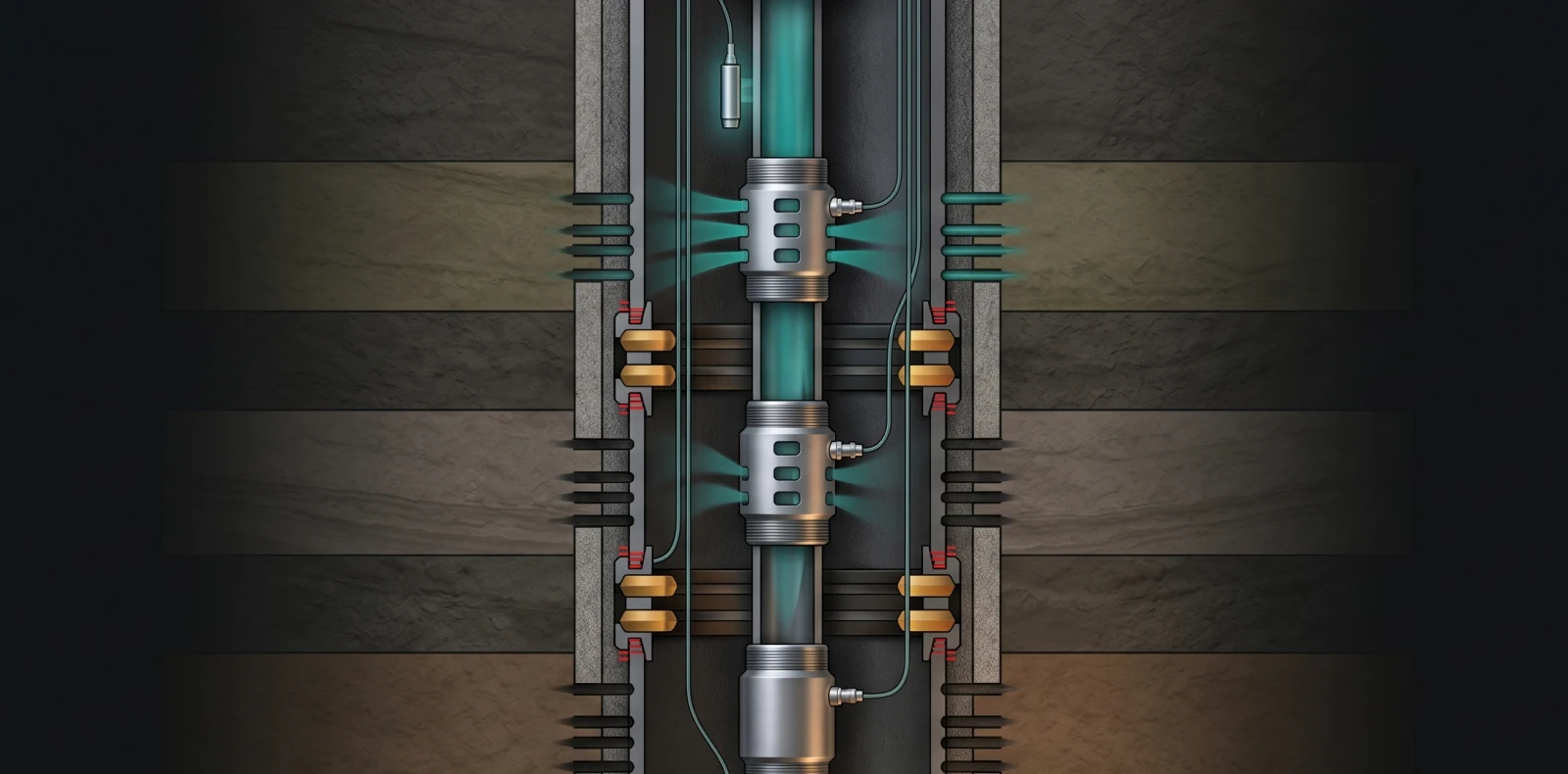
An intelligent completion integrates four core element groups: interval control valves (ICVs) that regulate zonal flow, inflow control devices (ICDs and autonomous AICDs) that balance influx along laterals, permanent downhole gauges and fiber-optic distributed sensing that stream pressure, temperature, and acoustic data, and surface control systems that close the monitoring-to-actuation loop.
Interval control valves are the actuators of the system. They regulate flow from each zone using an on-off or multiposition choke, and they come in hydraulic, electrohydraulic, and electric forms. Hydraulic ICVs remain the most common; some support up to ten discrete choke positions for fine zonal control.
Inflow control devices, including autonomous AICDs, balance influx along long horizontal laterals and mitigate the heel-toe effect that otherwise draws fluid unevenly. Permanent downhole gauges measure pressure and temperature continuously, while fiber-optic distributed sensing streams acoustic and temperature data to surface around the clock.
Surface control systems and analytics close the loop — monitor, analyze, then actuate the valves. Recent systems illustrate the direction of travel: a single electric line can now replace multiple hydraulic control lines, and fiber-optic sensing has been deployed across laterals exceeding 10,000 feet.
| Component | Function | Type |
| Interval Control Valve (ICV) | Regulates flow from each zone via on-off or multiposition choke | Hydraulic, electrohydraulic, electric |
| Inflow Control Device (ICD / AICD) | Balances influx along laterals; mitigates heel-toe effect | Passive / autonomous |
| Permanent Downhole Gauge (PDG) | Measures pressure and temperature continuously | Sensor |
| Fiber-optic distributed sensing (DAS/DTS) | Streams acoustic and temperature data 24/7 | Sensor / fiber |
| Surface control + analytics | Closes the monitor-analyze-actuate loop | Surface system |
Market Trends & Technology Evolution
The technology has followed a clear arc. Hydraulic systems came first — robust, proven, and strong in HPHT service — and still hold the largest share of the installed base. Electric systems arrived next, replacing multiple hydraulic lines with a single electric line for finer control and richer data. Hybrid designs now aim to combine the reliability of hydraulics with the precision of electrics.
Demand is concentrated where intervention is hardest and recovery most valuable: Brazil's pre-salt fields, Guyana's Stabroek block, and West African deepwater. All-electric momentum is real — Petrobras has awarded subsea packages featuring electric ICVs and downhole gauges to cut well count and workover frequency — but engineering realism matters: hydraulic and hybrid systems still dominate the wells in the ground today.
Closer to Maximus OIGA's home markets, expanding onshore and offshore activity across India, Southeast Asia, and Indonesia is driving demand for high-specification completion equipment, including the hardware that intelligent-completion systems are built around.
Applications & Where the Equipment Fits
Intelligent completions deliver the greatest value in multilateral, deepwater, and maximum-reservoir-contact wells where intervention is costly. Published field studies report water-production reductions above 50 percent and significant incremental recovery, with multilateral wells producing well above single-horizontal equivalents. The completion hardware — packers, flow control, and liner hangers — forms the mechanical foundation these systems are built upon.
The field data is compelling. One intelligent-well-completion study documented a 52.1 percent reduction in total field water production, while multilateral wells commonly produce more than 70 percent above a single horizontal equivalent. Technical papers indexed on SPE / OnePetro report installed reliability around 97 percent in a multilateral SmartWell field and incremental recovery of up to 1.02 million stock-tank barrels in coupled-simulator work.
The principle underneath these results is closed-loop reservoir management — predicting and preventing problems such as water or gas breakthrough rather than reacting after the fact. That is the value of intelligent completion in wells where you cannot easily go back downhole.
What is easy to miss is the mechanical foundation. ICVs, ICDs, and gauges are deployed on and around packers, flow-control sleeves, and liner hangers — the conventional completion hardware that isolates zones and anchors the string. The intelligence layer depends entirely on that hardware performing reliably for the life of the well.
Need expert guidance on the right solution?
Talk to our engineers about your project requirements.
The Maximus OIGA Perspective
Maximus OIGA is an API Q1 and ISO 14310 certified well-completion equipment manufacturer founded in 2011 in Vadodara, Gujarat, with monograms spanning API 11D1, 19LH, 19AC, 5CT, and 14L. The company does not manufacture intelligent-completion electronics — the ICVs, sensors, and fiber-optic systems are the domain of the systems vendors. What Maximus OIGA manufactures is the well completion equipment these systems are built around: packers, flow-control sleeves, liner hangers, bridge plugs, and downhole tools.
That distinction is the point. An intelligent completion is only as dependable as its mechanical foundation, and the foundation has to hold up in demanding wells. Maximus OIGA validates its completion hardware in an in-house test facility rated to 500 deg F and 15,000 PSI with real-time sensor monitoring — ratings that exceed its own products.
With 200+ installations across India, the Middle East, and Southeast Asia, and custom engineering for non-standard well parameters, the company sits close to the operators in those regions now adopting intelligent-completion architectures — supplying the reliable mechanical hardware that the intelligence layer sits on.
Common Misconceptions
Myth: intelligent completions are only for supermajors and megaprojects. In reality, modular and single-zone smart options exist, and adoption is broadening into cost-sensitive and emerging markets — the main barriers are upfront cost and integration complexity, not well size alone.
Myth: all-electric has replaced hydraulic. Hydraulic ICVs remain the most widely used; electric is gaining fastest in deepwater, but hybrid and hydraulic systems still dominate the installed base.
Myth: intelligent completion is just sensors. It is a closed-loop system that senses, analyzes, and actuates — and it is built on conventional completion hardware. A related myth, that smart wells eliminate completion hardware, has it backwards: zonal isolation and string anchoring still require packers and liner hangers regardless of the intelligence layer.
Frequently Asked Questions
What is intelligent well completion?
Intelligent well completion is a permanent downhole system that collects, transmits, and analyzes reservoir and production data and remotely controls flow from each zone without rig intervention. The core idea is closed-loop control: gauges and fiber-optic sensing measure conditions, surface analytics interpret them, and interval control valves act on the result. Also called smart well technology, it is deployed mainly in multi-zone, multilateral, deepwater, and subsea wells, and it is built on conventional completion hardware such as packers, flow control, and liner hangers.
What are the main components of an intelligent completion system?
There are four core element groups. Interval control valves (ICVs) regulate flow per zone and come in hydraulic, electrohydraulic, or electric forms. Inflow control devices, including autonomous AICDs, balance influx along long laterals and mitigate the heel-toe effect. Permanent downhole gauges and fiber-optic distributed sensing provide continuous pressure, temperature, and acoustic data. Surface control systems and analytics close the monitoring-to-actuation loop.
What is the difference between hydraulic and electric intelligent completions?
Hydraulic ICVs are the most widely used — robust, proven, and strong in HPHT service — but they require multiple control lines. Electric systems replace those multiple lines with a single electric line, enabling finer multi-zone control and more data. Hybrid systems combine both to balance reliability and precision. Hydraulic still dominates the installed base, while electric is gaining fastest in offshore and deepwater applications.
Are intelligent completions only for large offshore operators?
No. Deepwater and multilateral wells see the greatest value, but modular and single-zone smart options broaden access. The main barriers are upfront cost, complexity, and integration rather than well size alone, and adoption is expanding into cost-sensitive and emerging markets, including India and Southeast Asia. Regardless of the intelligence layer, reliable conventional completion hardware remains essential.
Next Steps
Intelligent completion is advancing quickly, but every system still rests on dependable mechanical hardware. Maximus OIGA manufactures the packers, flow control, and liner hangers that this technology is built around, validated for demanding wells. Explore the full well completion equipment range to see where the foundation comes from.
Related Blogs

More Information
Related News & Insights
Best bridge plug manufacturers in Asia
Thirteen bridge plug manufacturers in Asia — China, India and the UAE — compared on seven points, across drillable, retrievable, composite and dissolvable plug types.
October 20, 2026
Best downhole tool manufacturers in Asia
Fourteen downhole tool makers in Asia — China, India, Indonesia and the UAE — compared on seven points and on which of the six completion-tool families each one builds.
October 20, 2026
API 11D1 vs ISO 14310 - what a V0 rating actually certifies
What a V0 rating really means under API 11D1 and ISO 14310 — and ten checks that take a packer or bridge plug claim from the brochure line to the validation record behind it.
October 20, 2026
Indian downhole completion tool manufacturers compared: API status, plants, catalogue and lead times
Most Indian suppliers list packers, bridge plugs and liner hangers. The harder question is who actually makes the goods, where, and what documents arrive with the order. This comparison puts six Indian downhole tool manufacturers side by side on manufacture, plant location, catalogue breadth, published lead times and the documentation pack, using only what each company publishes about itself.
September 25, 2026
Zonal isolation systems
A bridge plug, a packer, a cement retainer, a straddle packer or a stage cementing collar can each be the right way to isolate an interval in a cased well. Which one depends on where the zone sits, how long the isolation must hold, and whether cement goes through the tool. This guide maps each isolation job to its tool class and its named SpectraMax models, then covers what to specify, how each tool sets and seals, and where each option stops working. It also sets out the records that ship with the order and the lead-time bands by product class, so you can plan the run before the quotation arrives.
September 25, 2026
Casing scrapers
A packer, bridge plug or cement retainer only grips and seals on a clean casing wall, and the scraper that cleans it has to fit your casing on the way down and at depth. This guide covers how a casing scraper cleans, the three main configurations, and how to size one to your casing OD and weight range, with worked ID and drift figures for 5-1/2 in, 7 in and 9-5/8 in casing. It then matches each configuration to its well condition, sets out where every option stops working, and lists the records that should ship with the order.
September 25, 2026
Gas anchors
Low fillage, fluid pound or a gas-locked rod pump usually points to the same tool below the pump: a gas anchor. Which configuration fits depends on whether the pump can sit below the perforations, how much liquid it displaces, and whether solids or deviation are in play. This guide works through the four configurations by well condition, then covers the sizing rule, the specifications a quotation has to fix, and where each option stops working. It also sets out the records that should ship with the part and the SpectraMax lead-time bands by product class.
September 25, 2026
Coiled tubing tools
"Coiled tubing tools" covers three different things: the surface spread, the intervention bottom-hole assembly, and the completion tools coiled tubing conveys and sets. Only the third group is manufactured completion equipment, and it is the group this page is about. It covers what conveyance changes about the tool itself, which of the three families (bridge plug, cement retainer, packer) suits which job, and the six inputs a supplier needs to quote one. It also sets out where each option stops, the records to ask any supplier for, and the lead-time bands by product class.
September 21, 2026
Saudi Aramco vendor registration for completion equipment suppliers
Saudi Aramco vendor registration is a prequalification on Aramco's e-Marketplace that ends in a Vendor ID, and being registered is not the same as being qualified. This guide walks the out-of-Kingdom route for a completion equipment manufacturer: how Aramco weighs financial strength, technical qualification and IKTVA local content, and which documents an international supplier actually files instead of the Saudi statutory set. It also sets out what a manufacturer can carry for your submission, what stays with you, and the records to ask any supplier for before a purchase order.
September 21, 2026
ONGC vendor registration for downhole tool suppliers: the actual sequence
Selling downhole tools to ONGC starts with a commercial gate, not the technical bid: you complete supplier self-registration on ONGC e-Procurement, get a bidder User-ID, then finish vendor enlistment before you can bid on a single tender. This guide walks the actual sequence, the documents an Indian or overseas applicant submits, how ONGC weighs a bid once local content is applied, and a realistic timeline. It is honest about what a manufacturer can and cannot do for your bid, and what to ask any supplier for in writing.
September 21, 2026