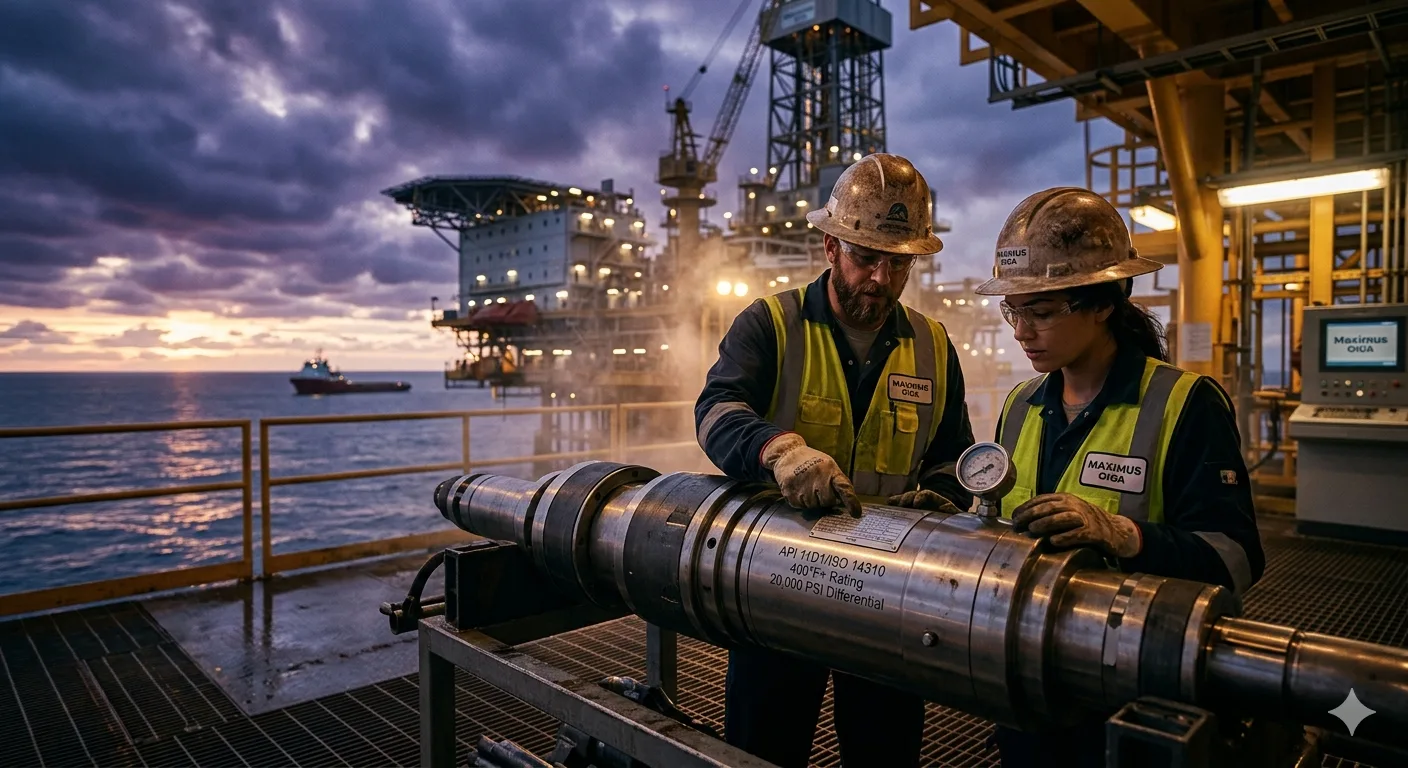
Types of Packers in Well Completion: Complete Selection Guide for Engineers
Published:
Well completion packers are classified into five primary types: permanent, retrievable, mechanical-set, hydraulic-set, and specialized (inflatable, swellable, cup).
Well completion packers are classified into five primary types: permanent, retrievable, mechanical-set, hydraulic-set, and specialized (inflatable, swellable, cup). Each is rated for specific pressure, temperature, and well deviation conditions per API 11D1/ISO 14310 standards.
There are five primary types of packers used in well completion, each engineered for specific downhole conditions ranging from 150 degrees F to 500 degrees F+. A packer seals the annular space between tubing and casing, protecting the casing string from production fluids and pressures.
This guide classifies packers using two frameworks that mirror how completion engineers evaluate them: by retrievability (permanent vs. retrievable) and by setting mechanism (mechanical, hydraulic, wireline, hydrostatic). A third category covers specialized packers designed for extreme or unconventional applications.
Why Understanding Packer Types Matters
Over 90% of well completions worldwide use packers. The packer itself represents a small fraction of total well cost, but selecting the wrong type triggers seal failure, production downtime, and workover operations that can cost 10x the original equipment price.
Wrong packer selection most commonly fails in one of three ways: elastomer degradation from exceeding temperature ratings, extrusion from exceeding differential pressure limits, or inability to set in deviated wellbores due to mechanism limitations. Each failure mode maps directly to packer type selection. Understanding the classification system allows engineers to match well conditions to the correct packer category before evaluating individual products or manufacturers.
Types of Packers by Retrievability
Permanent packers withstand differential pressures exceeding 5,000 PSI and temperatures above 300 degrees F, set by wireline or tubing. Retrievable packers offer workover flexibility with mechanical or hydraulic release, rated for moderate conditions in wells requiring periodic intervention.
The most fundamental classification divides packers into permanent and retrievable types. A third hybrid category combines elements of both.
Permanent Packers. Permanent packers are designed for long-life completions where the packer remains in the well for the duration of production. Removal requires milling out the packer body. These packers achieve higher differential pressure ratings (exceeding 5,000 PSI) and temperature ratings (above 300 degrees F) than retrievable designs. The simpler mechanical design results in a smaller outside diameter, providing better running clearance in tight casing. Halliburton permanent packers are rated up to 20,000 PSI at 475 degrees F (246 degrees C).
Retrievable Packers. Retrievable packers can be unset and pulled from the well via mechanical manipulation or hydraulic release. This allows workover operations, packer inspection, and reuse after redressing. The trade-off: retrievable designs carry lower pressure and temperature ratings than permanent packers due to the additional release mechanism complexity. Halliburton retrievable packers are rated up to 15,000 PSI at 400 degrees F (204 degrees C).
Permanent-Retrievable Hybrid. Hybrid packers combine permanent-grade pressure and temperature ratings with retrieval capability via a dedicated workstring. The bore size is generally smaller than a true permanent packer, but the ability to retrieve without milling reduces total intervention cost in wells where future workover access is planned.
Selection rule: Use a permanent packer when differential pressure exceeds 5,000 PSI, temperature exceeds 225 degrees F, or H2S is present with temperatures below 160 degrees F. Otherwise, a retrievable packer provides the workover flexibility most operators need.
| Feature | Permanent | Retrievable | Perm/Retrievable Hybrid | Best Use Case |
| Pressure Rating | >5,000 PSI (up to 20,000) | Up to 15,000 PSI | Permanent-grade | Permanent for extreme P |
| Temperature Rating | >300°F (up to 475°F) | Up to 400°F | Near-permanent grade | Permanent for HPHT |
| Setting Method | Wireline or tubing | Tubing (mech/hyd) | Tubing + workstring | Application-dependent |
| Removal | Milling only | Mechanical/hydraulic release | Workstring retrieval | Retrievable for workovers |
| OD / Clearance | Smaller OD | Larger OD | Mid-range OD | Permanent for tight casing |
| Reusability | No (milled out) | Yes (after redress) | Yes (after redress) | Retrievable for reuse |
Types of Packers by Setting Mechanism
Mechanical-set packers use tubing rotation, tension, or compression for activation in shallow vertical wells. Hydraulic-set packers use fluid pressure to engage slips and elements, making them the preferred choice for deviated, horizontal, and deepwater wells where tubing manipulation is restricted.
The second classification framework groups packers by how they are activated downhole. The setting mechanism determines which well geometries and completion scenarios a packer can serve.
Mechanical-Set Packers. Mechanical-set packers activate through tubing manipulation: rotation (right-hand turns), tension (pulling up), or compression (slacking off weight). These mechanisms work reliably in shallow, vertical wells with low differential pressure. The limitation: tubing manipulation becomes unreliable or impossible in highly deviated and horizontal wells where friction prevents force transmission to the packer.
Hydraulic-Set Packers. Hydraulic-set packers use applied fluid pressure to drive a piston that engages the slips and packing element. No tubing movement is required. This makes hydraulic-set packers the standard for deviated wells, horizontal completions, deepwater operations, and multiple-packer completions where several packers must be set in sequence without disturbing previously set tools.
Wireline-Set (Electric) Packers. Wireline-set packers use an explosive charge to detonate and mechanically lock slips and elements into position. This is the most common setting method for permanent packers. Wireline setting allows precise depth placement using correlation logs, independent of tubing position.
Hydrostatic-Set Packers. Hydrostatic-set packers activate using existing wellbore hydrostatic pressure, requiring no intervention after running in hole. These are designed for HPHT and highly deviated wells where other setting methods face reliability challenges. Halliburton hydrostatic-set packers are rated up to 28,000 PSI for extreme deepwater applications.
| Setting Method | Mechanism | Best Well Type | Deviation Limit | Pressure Limit |
| Mechanical | Rotation / tension / compression | Shallow vertical | Low deviation | Low-moderate |
| Hydraulic | Applied fluid pressure (piston) | Deviated / horizontal / deepwater | Any deviation | High |
| Wireline (Electric) | Explosive charge | Any (permanent packers) | Any | High |
| Hydrostatic | Wellbore hydrostatic pressure | HPHT / extreme deepwater | Any | Up to 28,000 PSI |
Specialized Packers for Specific Applications
Specialized packers include thermal designs rated above 400 degrees F for SAGD and geothermal applications, swellable elastomer packers for open-hole completions, and inflatable packers for irregular wellbore geometries in exploration and remedial operations.
Beyond the standard permanent/retrievable and mechanical/hydraulic classifications, several packer types are engineered for conditions that fall outside conventional completion parameters.
Thermal Packers. Thermal packers are rated for continuous operation at 350 degrees F to 450 degrees F+ in SAGD (steam-assisted gravity drainage), CSS (cyclic steam stimulation), and geothermal wells. Standard elastomers (NBR, HNBR) degrade above 302 degrees F. Thermal packers use FKM (to 392 degrees F) or FFKM (to 446 degrees F+) elastomers with metallic anti-extrusion backup systems. The Maximus OIGA SpectraMax series is rated for 400 degrees F+ continuous operation.
Swellable Packers. Swellable packers use elastomer elements that expand on contact with oil or water in the wellbore. No mechanical setting mechanism is required. These packers are designed for open-hole completions where conventional slip-type packers cannot grip formation rock. The swell process takes hours to days depending on fluid type and temperature.
Inflatable Packers. Inflatable packers use a fluid-inflated bladder to seal against the wellbore wall. They accommodate large casing or open holes with irregular geometries where rigid slip-type packers cannot achieve seal. Primary applications include exploration drilling, remedial cementing, and well testing in oversized or washed-out intervals.
Cup Packers. Cup packers use flexible cup-shaped elements that seal against the casing ID under differential pressure. They are used for well testing, treating, and shallow well operations where the simplicity of the cup design provides adequate isolation without the complexity of slip-and-element packer systems.
Service Packers. Service packers are temporary-use tools for well testing, cement squeezing, acidizing, and fracturing operations. Unlike production packers (which are purchased and remain in the well), service packers are typically rented and retrieved after the operation.
.
| Type | Temp Rating | Application | Elastomer | Setting Method | Best For |
| Thermal | 350-450°F+ | SAGD, CSS, Geothermal | FKM / FFKM | Hydraulic / wireline | Continuous high temp |
| Swellable | Standard | Open-hole completions | Oil/water-reactive | Self-activating (swell) | No-cement isolation |
| Inflatable | Standard | Exploration, remedial | Standard bladder | Fluid inflation | Irregular wellbores |
| Cup | Standard | Testing, treating | Flexible cup elements | Differential pressure | Shallow / simple wells |
| Service | Varies | Testing, frac, acidize | Varies | Mechanical / hydraulic | Temporary operations |
Maximus OIGA: Packer Engineering Authority
Maximus OIGA manufactures packers across multiple categories: hydraulic, mechanical, thermal, cup, and dual configurations. The company holds API Q1, ISO 14310, and ISO 9001 certifications, with an in-house ISO-certified test facility at its Vadodara, Gujarat manufacturing base.
The SpectraMax Thermal Packer series, developed through 18 months of dedicated R&D, is rated for 400 degrees F+ continuous operation using proprietary high-temperature elastomers. The PAK VI Hydraulic Retrievable Production Packer serves standard completion applications.
Maximus OIGA has completed 200+ packer installations across India, the Middle East, and Southeast Asia. The company engineers custom packer configurations for specific well conditions, matching elastomer grade, element hardness, anti-extrusion backup, and casing size to each application.
Common Misconceptions About Packers
All packers function the same way. Each packer type is engineered for specific pressure, temperature, and deviation conditions. A mechanical-set packer that works reliably in a vertical well at 3,000 PSI will fail in a horizontal well at the same pressure because the setting mechanism cannot transmit force through friction. Packer selection is condition-specific, not interchangeable.
Retrievable packers are always inferior to permanent. Modern retrievable packers rated at 15,000 PSI and 400 degrees F rival permanent packer performance in most conventional wells. The gap narrows further with hybrid designs. Permanent packers remain necessary only in extreme HPHT or sour-service conditions.
Indian manufacturers cannot match API standards. Maximus OIGA holds API Q1 quality management certification and ISO 14310 product certification with in-house design verification testing. API and ISO certifications are audited against the same criteria globally, regardless of manufacturing location.
Frequently Asked Questions About Types of Packers
How many types of packers are there in well completion?
Five primary types classified by retrievability and setting mechanism: permanent, retrievable, mechanical-set, hydraulic-set, and specialized. The specialized category includes thermal, swellable, inflatable, and cup packers, each designed for specific downhole conditions.
The industry also distinguishes between production packers (purchased, remain in well for life of completion) and service packers (rented, used temporarily for testing, fracturing, or acidizing). Maximus OIGA manufactures across multiple categories including the SpectraMax thermal packer series.
What is the difference between a retrievable and permanent packer?
Permanent packers are removed only by milling and achieve higher pressure/temperature ratings (exceeding 5,000 PSI and 300 degrees F). Retrievable packers can be pulled mechanically or hydraulically, offering workover flexibility at lower P/T ratings. Decision factors include expected differential pressure, temperature, H2S presence, workover plans, and well deviation.
How do you select the right packer for a well?
Evaluate well conditions first: temperature, pressure, depth, deviation, H2S/CO2 presence, and completion type. Match the elastomer to temperature: NBR (below 212 degrees F), HNBR (below 302 degrees F), FKM (below 392 degrees F), FFKM (below 446 degrees F+). Verify the manufacturer holds API 11D1/ISO 14310 certification and confirm the specific validation grade: V0 for gas-tight service, V3 for liquid service. Maximus OIGA engineers custom-configure packers to specific well conditions.
What is a V0 rating for packers?
V0 is the highest design verification grade under API 11D1/ISO 14310. It requires gas-tight performance tested with air or nitrogen as the test medium, with zero gas leakage permitted at rated pressure and temperature. The progressive grades range from V6 (minimum, manufacturer-defined conditions) to V0 (most rigorous). V3 uses liquid test medium, while V0 uses gas, making it significantly more demanding.
Can oil and gas packers be used in geothermal wells?
Standard production packers are not rated for geothermal temperatures, which exceed 400 degrees F continuous operation. Geothermal wells require specialized thermal packer designs using FFKM or FKM elastomers rated for sustained high-temperature exposure. Key challenges include corrosive geothermal fluids and 20-30 year service life requirements. The Maximus OIGA SpectraMax thermal packer series is designed for 400 degrees F+ applications including geothermal wells.
Related Blogs

More Information
Related News & Insights
Best bridge plug manufacturers in Asia
Thirteen bridge plug manufacturers in Asia — China, India and the UAE — compared on seven points, across drillable, retrievable, composite and dissolvable plug types.
October 20, 2026
Best downhole tool manufacturers in Asia
Fourteen downhole tool makers in Asia — China, India, Indonesia and the UAE — compared on seven points and on which of the six completion-tool families each one builds.
October 20, 2026
API 11D1 vs ISO 14310 - what a V0 rating actually certifies
What a V0 rating really means under API 11D1 and ISO 14310 — and ten checks that take a packer or bridge plug claim from the brochure line to the validation record behind it.
October 20, 2026
Indian downhole completion tool manufacturers compared: API status, plants, catalogue and lead times
Most Indian suppliers list packers, bridge plugs and liner hangers. The harder question is who actually makes the goods, where, and what documents arrive with the order. This comparison puts six Indian downhole tool manufacturers side by side on manufacture, plant location, catalogue breadth, published lead times and the documentation pack, using only what each company publishes about itself.
September 25, 2026
Zonal isolation systems
A bridge plug, a packer, a cement retainer, a straddle packer or a stage cementing collar can each be the right way to isolate an interval in a cased well. Which one depends on where the zone sits, how long the isolation must hold, and whether cement goes through the tool. This guide maps each isolation job to its tool class and its named SpectraMax models, then covers what to specify, how each tool sets and seals, and where each option stops working. It also sets out the records that ship with the order and the lead-time bands by product class, so you can plan the run before the quotation arrives.
September 25, 2026
Casing scrapers
A packer, bridge plug or cement retainer only grips and seals on a clean casing wall, and the scraper that cleans it has to fit your casing on the way down and at depth. This guide covers how a casing scraper cleans, the three main configurations, and how to size one to your casing OD and weight range, with worked ID and drift figures for 5-1/2 in, 7 in and 9-5/8 in casing. It then matches each configuration to its well condition, sets out where every option stops working, and lists the records that should ship with the order.
September 25, 2026
Gas anchors
Low fillage, fluid pound or a gas-locked rod pump usually points to the same tool below the pump: a gas anchor. Which configuration fits depends on whether the pump can sit below the perforations, how much liquid it displaces, and whether solids or deviation are in play. This guide works through the four configurations by well condition, then covers the sizing rule, the specifications a quotation has to fix, and where each option stops working. It also sets out the records that should ship with the part and the SpectraMax lead-time bands by product class.
September 25, 2026
Coiled tubing tools
"Coiled tubing tools" covers three different things: the surface spread, the intervention bottom-hole assembly, and the completion tools coiled tubing conveys and sets. Only the third group is manufactured completion equipment, and it is the group this page is about. It covers what conveyance changes about the tool itself, which of the three families (bridge plug, cement retainer, packer) suits which job, and the six inputs a supplier needs to quote one. It also sets out where each option stops, the records to ask any supplier for, and the lead-time bands by product class.
September 21, 2026
Saudi Aramco vendor registration for completion equipment suppliers
Saudi Aramco vendor registration is a prequalification on Aramco's e-Marketplace that ends in a Vendor ID, and being registered is not the same as being qualified. This guide walks the out-of-Kingdom route for a completion equipment manufacturer: how Aramco weighs financial strength, technical qualification and IKTVA local content, and which documents an international supplier actually files instead of the Saudi statutory set. It also sets out what a manufacturer can carry for your submission, what stays with you, and the records to ask any supplier for before a purchase order.
September 21, 2026
ONGC vendor registration for downhole tool suppliers: the actual sequence
Selling downhole tools to ONGC starts with a commercial gate, not the technical bid: you complete supplier self-registration on ONGC e-Procurement, get a bidder User-ID, then finish vendor enlistment before you can bid on a single tender. This guide walks the actual sequence, the documents an Indian or overseas applicant submits, how ONGC weighs a bid once local content is applied, and a realistic timeline. It is honest about what a manufacturer can and cannot do for your bid, and what to ask any supplier for in writing.
September 21, 2026