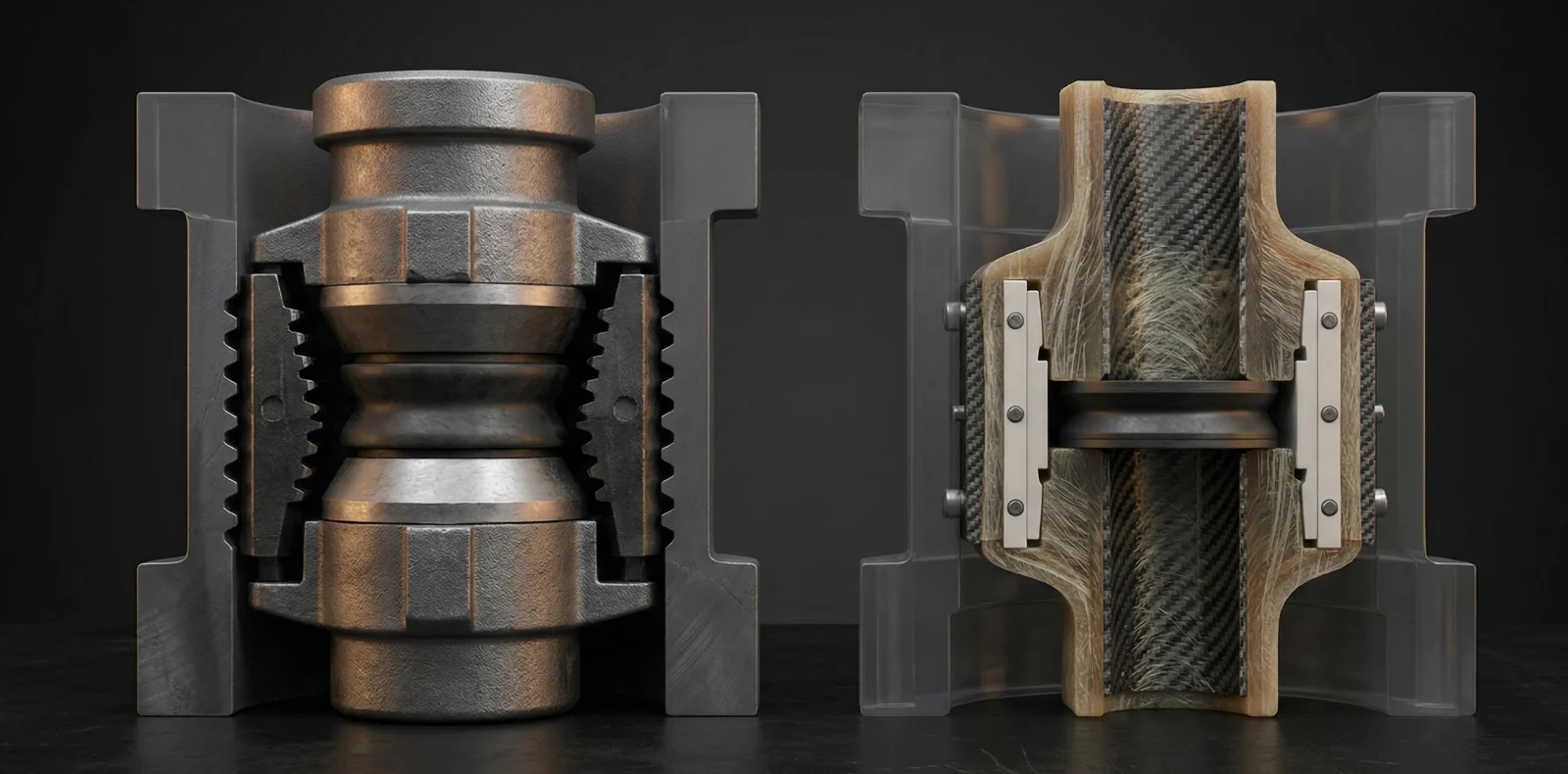
Cast Iron vs Composite Bridge Plug: Complete Comparison for Engineers
Published:
Cast iron bridge plugs provide permanent well isolation with pressure ratings up to 10,000 psi and temperature ratings to 400°F, making them the standard for well abandonment and zone isolation. Composite bridge plugs offer faster drillout times with lightweight cuttings, rated 6,000–10,000 psi, ideal for temporary isolation and multi-zone stimulation operations.
Cast iron delivers maximum pressure integrity and proven reliability for permanent isolation. Composite offers faster drillout and eliminates milling operations. The difference between a cast iron and composite bridge plug comes down to application: permanent seal versus operational efficiency. What’s the difference and which one do I need? This guide compares both materials across every specification that matters for well completion decisions.
Cast Iron vs Composite Bridge Plug: Side-by-Side Comparison
The primary differences between cast iron and composite bridge plugs lie in drillability, pressure rating, and intended application. Cast iron plugs require milling operations for removal but offer proven long-term seal integrity. Composite plugs drill out in minutes with standard bits, generating lightweight cuttings that circulate easily from the wellbore.
The comparison table below covers every decision-critical specification. Both plug types provide effective well isolation—the selection depends on whether the application demands permanent sealing or operational speed.
| Criteria | Cast Iron Bridge Plug | Composite Bridge Plug |
| Material | Gray iron body, rotationally locked slips, elastomer elements | Fiberglass + carbon fiber + glass-reinforced epoxy (SG 1.8–1.9) |
| Pressure Rating | 5,000–10,000 psi | 6,000–10,000 psi (HPHT version) |
| Temperature Rating | 250–400°F (nitrile to viton elastomers) | 250–300°F |
| Drillout Time | Several hours (milling required) | 6 minutes or less (standard bits) |
| Drillout Debris | Heavy metal cuttings | Lightweight cuttings (SG 1.8–1.9) |
| Setting Method | Wireline, tubing, or coiled tubing | Wireline, tubing, coiled tubing, or pump-down |
| Casing Size Range | 2-3/8” to 20” | 2-7/8” to 9-5/8” |
| Primary Application | Permanent isolation: P&A, zone isolation, squeeze cementing | Temporary isolation: multi-zone stimulation, horizontal completions |
| Cost | Lower per unit | Higher per unit; lower total cost with drillout savings |
| Manufacturer | Maximus OIGA, NOV, Weatherford, Expro | Maximus OIGA, Weatherford FracGuard, Repeat Precision |
Cast Iron Bridge Plug: Specifications, Pros, and Applications
Cast iron bridge plugs are fully drillable permanent isolation tools available in casing sizes from 2-3/8 inch to 20 inch. Manufactured to API 11D1 specifications with validation grades from V6 to V0, they provide reliable sealing for well abandonment, squeeze cementing, and zonal isolation operations.
How It Works. A cast iron bridge plug uses full-circle slips to grip the casing wall, an elastomer element to create the pressure seal, and a cast iron body to hold differential pressure. Pinned cones prevent premature setting during run-in. A top vent allows pressure equalization during drillout operations.
Key Design Feature. Cast iron bridge plugs are modular—many designs are convertible to cement retainers (PCR configuration) by adding a cementing port. This dual functionality reduces inventory requirements for operators running both isolation and squeeze cementing programs.
Cast iron bridge plug specs range from 5,000 psi to 10,000 psi differential pressure. Standard nitrile elastomers handle 250–300°F (121–149°C). Viton elastomers extend the operating range to 400°F (204°C). AFLAS compounds are available for sour service (H₂S) applications. Casing grade compatibility covers standard grades up to P-110, with Q-125 available on custom order.
| Specification | Cast Iron Bridge Plug |
| Pressure Rating | 5,000 psi and 10,000 psi versions |
| Temperature Range | 250–300°F (nitrile); up to 400°F (viton); AFLAS for sour service |
| Casing Sizes | 2-3/8” to 20” |
| API Standard | API 11D1, validation grades V6 to V0 |
| Setting Methods | Wireline, tubing, coiled tubing |
| Casing Grade Compatibility | Up to P-110 standard; Q-125 custom available |
| Special Features | Top vent for pressure equalization; convertible to cement retainer (PCR); pinned cones prevent preset |
Pros: Proven long-term reliability for permanent isolation. Highest pressure integrity across widest casing range (to 20”). Lowest per-unit cost. API 11D1 compliant with V0 gas-tight validation available. Convertible to cement retainer.
Cons: Drillout requires several hours with specialized milling tools. Heavy metal cuttings can accumulate in horizontal sections. Non-retrievable—once set, removal requires milling. Milling operations generate iron debris that must be circulated from the wellbore.
Ideal Applications: Well abandonment (P&A), permanent zone isolation, squeeze cementing, large-bore installations above 9-5/8” casing, high-temperature wells above 300°F.
Need expert guidance on the right solution?
Talk to our engineers about your project requirements.
Composite Bridge Plug: Specifications, Pros, and Applications
Composite bridge plugs utilize engineered fiberglass, carbon fiber, and glass-reinforced epoxy construction for rapid drillout and reduced debris. Available in standard (6,000 psi/250°F) and HPHT (10,000 psi/300°F) configurations, composite plugs are the preferred choice for multi-zone stimulation in horizontal and multilateral wellbores.
How It Works. Composite bridge plugs use filament-wound or convolute-wrapped fiberglass and resin bodies instead of metal. Slips incorporate ceramic buttons or tungsten inserts (hardness >30 HRC) to grip P-110 casing. The composite body disintegrates rapidly under standard drill bits, producing lightweight cuttings with a specific gravity of 1.8–1.9 that circulate out of the wellbore without accumulating.
Key Design Feature. Composite bridge plug advantages center on stackability. In multi-zone completions, lightweight cuttings from upper plugs do not pile on lower plugs—a critical factor in horizontal wells where debris management determines completion efficiency. Some composite designs include a beveled bottom to prevent spinning during drillout.
Standard composite models are rated at 6,000 psi and 250°F (121°C). HPHT versions reach 10,000 psi and 300°F (149°C). Drillout takes 6 minutes or less with tricone or junk-mill bits. Permian Basin field data shows plug-and-perf operations reduced from 8 days to 4 days per well when switching from cast iron to composite systems. Some composite designs offer retrievable configurations for temporary applications.
Pros: Drillout in 6 minutes or less. Lightweight debris eliminates accumulation in horizontal wells. Stackable for multi-zone completions. Pump-down setting capability. Some designs are retrievable.
Cons: Higher per-unit cost than cast iron. Narrower casing range (2-7/8” to 9-5/8” maximum). Lower maximum temperature (300°F vs 400°F for cast iron with viton). Ceramic slip inserts can occasionally challenge mill bits during drillout.
Ideal Applications: Multi-stage horizontal fracturing (plug-and-perf), temporary zone isolation, cost-sensitive multi-well programs where drillout time savings offset higher unit cost, horizontal and multilateral completions.
Which Bridge Plug Is Right for Your Well?
The choice between drillable vs non-drillable bridge plug materials depends on well conditions, completion objectives, and operational timeline. The decision matrix below maps seven common applications to the recommended plug type.
| Well Condition / Application | Recommended | Reason |
| Permanent well abandonment (P&A) | Cast Iron | Proven long-term seal; API 11D1 V0 gas-tight; casing range to 20” |
| Multi-stage horizontal fracturing | Composite | 6-minute drillout; lightweight cuttings; stackable; pump-down capable |
| Squeeze cementing operations | Cast Iron | Convertible to cement retainer (PCR); highest pressure integrity |
| Temporary zone isolation | Composite | Retrievable options available; fast removal without milling |
| Wells above 300°F (150°C) | Cast Iron | Viton elastomers rated to 400°F; composite max 300°F |
| Cost-sensitive multi-well programs | Composite | Higher unit cost offset by drillout savings (Permian: 8→4 days per well) |
| Large-bore casing (>9-5/8”) | Cast Iron | Available to 20”; composite limited to 9-5/8” maximum |
Maximus OIGA manufactures both cast iron and composite bridge plugs to API 11D1 and ISO 14310 standards. Engineers who need to justify their selection to a technical manager can reference the specifications and application matches in the tables above—the data supports either choice depending on well conditions.
Frequently Asked Questions
What is a cast iron bridge plug?
A cast iron bridge plug is a fully drillable permanent isolation tool designed to seal a wellbore at a specific depth. Cast iron bridge plugs handle differential pressures up to 10,000 psi across casing sizes from 2-3/8” to 20”. They are manufactured to API 11D1 specifications and set via wireline, tubing, or coiled tubing. Maximus OIGA manufactures API 11D1 compliant cast iron bridge plugs with validation grades from V6 to V0 for gas-tight isolation.
What are the advantages of composite bridge plugs over cast iron?
Composite bridge plugs drill out in 6 minutes or less compared to several hours for cast iron. The lightweight cuttings (specific gravity 1.8–1.9) circulate easily from the wellbore without accumulating—critical for horizontal completions. Composite plugs are stackable for multi-zone operations and some designs are retrievable. The trade-off: higher per-unit cost, narrower casing range (maximum 9-5/8”), and lower maximum temperature (300°F versus 400°F for cast iron with viton elastomers).
Can both cast iron and composite bridge plugs handle 10,000 psi?
Yes. Cast iron bridge plugs are available in standard 10,000 psi configurations across a wide casing range. Composite HPHT models (such as Weatherford’s FracGuard FP10) are also rated to 10,000 psi at 300°F. The key difference at 10,000 psi is temperature: cast iron with viton elastomers handles up to 400°F, while composite HPHT versions are limited to 300°F. Which performs better in high-pressure wells depends on the concurrent temperature conditions.
How long does it take to drill out a cast iron bridge plug versus a composite?
Cast iron bridge plug drillout requires several hours using specialized milling tools and generates heavy metal cuttings. Composite bridge plugs drill out in 6 minutes or less with standard tricone or junk-mill bits. In Permian Basin field operations, plug-and-perf completions using composite plugs reduced total well time from 8 days to 4 days per well. The drillout time savings typically offset the higher per-unit cost of composite plugs in multi-well fracturing programs.
Which bridge plug type is recommended for well abandonment?
Cast iron bridge plugs are the standard for permanent well abandonment (P&A) operations. They provide proven long-term seal integrity, are available in casing sizes up to 20”, and achieve API 11D1 V0 gas-tight validation—the highest seal assurance grade. Cast iron’s track record in permanent isolation applications spans decades of field verification. Maximus OIGA manufactures both cast iron and composite bridge plugs and advises selection based on specific P&A program requirements.
Related Blogs

More Information
Related News & Insights
Best bridge plug manufacturers in Asia
Thirteen bridge plug manufacturers in Asia — China, India and the UAE — compared on seven points, across drillable, retrievable, composite and dissolvable plug types.
October 20, 2026
Best downhole tool manufacturers in Asia
Fourteen downhole tool makers in Asia — China, India, Indonesia and the UAE — compared on seven points and on which of the six completion-tool families each one builds.
October 20, 2026
API 11D1 vs ISO 14310 - what a V0 rating actually certifies
What a V0 rating really means under API 11D1 and ISO 14310 — and ten checks that take a packer or bridge plug claim from the brochure line to the validation record behind it.
October 20, 2026
Indian downhole completion tool manufacturers compared: API status, plants, catalogue and lead times
Most Indian suppliers list packers, bridge plugs and liner hangers. The harder question is who actually makes the goods, where, and what documents arrive with the order. This comparison puts six Indian downhole tool manufacturers side by side on manufacture, plant location, catalogue breadth, published lead times and the documentation pack, using only what each company publishes about itself.
September 25, 2026
Zonal isolation systems
A bridge plug, a packer, a cement retainer, a straddle packer or a stage cementing collar can each be the right way to isolate an interval in a cased well. Which one depends on where the zone sits, how long the isolation must hold, and whether cement goes through the tool. This guide maps each isolation job to its tool class and its named SpectraMax models, then covers what to specify, how each tool sets and seals, and where each option stops working. It also sets out the records that ship with the order and the lead-time bands by product class, so you can plan the run before the quotation arrives.
September 25, 2026
Casing scrapers
A packer, bridge plug or cement retainer only grips and seals on a clean casing wall, and the scraper that cleans it has to fit your casing on the way down and at depth. This guide covers how a casing scraper cleans, the three main configurations, and how to size one to your casing OD and weight range, with worked ID and drift figures for 5-1/2 in, 7 in and 9-5/8 in casing. It then matches each configuration to its well condition, sets out where every option stops working, and lists the records that should ship with the order.
September 25, 2026
Gas anchors
Low fillage, fluid pound or a gas-locked rod pump usually points to the same tool below the pump: a gas anchor. Which configuration fits depends on whether the pump can sit below the perforations, how much liquid it displaces, and whether solids or deviation are in play. This guide works through the four configurations by well condition, then covers the sizing rule, the specifications a quotation has to fix, and where each option stops working. It also sets out the records that should ship with the part and the SpectraMax lead-time bands by product class.
September 25, 2026
Coiled tubing tools
"Coiled tubing tools" covers three different things: the surface spread, the intervention bottom-hole assembly, and the completion tools coiled tubing conveys and sets. Only the third group is manufactured completion equipment, and it is the group this page is about. It covers what conveyance changes about the tool itself, which of the three families (bridge plug, cement retainer, packer) suits which job, and the six inputs a supplier needs to quote one. It also sets out where each option stops, the records to ask any supplier for, and the lead-time bands by product class.
September 21, 2026
Saudi Aramco vendor registration for completion equipment suppliers
Saudi Aramco vendor registration is a prequalification on Aramco's e-Marketplace that ends in a Vendor ID, and being registered is not the same as being qualified. This guide walks the out-of-Kingdom route for a completion equipment manufacturer: how Aramco weighs financial strength, technical qualification and IKTVA local content, and which documents an international supplier actually files instead of the Saudi statutory set. It also sets out what a manufacturer can carry for your submission, what stays with you, and the records to ask any supplier for before a purchase order.
September 21, 2026
ONGC vendor registration for downhole tool suppliers: the actual sequence
Selling downhole tools to ONGC starts with a commercial gate, not the technical bid: you complete supplier self-registration on ONGC e-Procurement, get a bidder User-ID, then finish vendor enlistment before you can bid on a single tender. This guide walks the actual sequence, the documents an Indian or overseas applicant submits, how ONGC weighs a bid once local content is applied, and a realistic timeline. It is honest about what a manufacturer can and cannot do for your bid, and what to ask any supplier for in writing.
September 21, 2026