DLT Retrievable Packer: Specifications, Applications & Technical Guide
Published:
The DLT retrievable packer has been a proven mechanical-set design across Indian and Middle Eastern workover operations for more than two decades. Originally developed by D&L Oil Tools in Texas, the architecture has since become a de facto industry standard manufactured under licence and as equivalent designs by suppliers worldwide — including Maximus OIGA, which produces the SpectraMax DLT Retrievable Packer at its API Q1 certified facility in Vadodara, Gujarat.
The DLT retrievable packer has been a proven mechanical-set design across Indian and Middle Eastern workover operations for more than two decades. Originally developed by D&L Oil Tools in Texas, the architecture has since become a de facto industry standard manufactured under licence and as equivalent designs by suppliers worldwide — including Maximus OIGA, which produces the SpectraMax DLT Retrievable Packer at its API Q1 certified facility in Vadodara, Gujarat.
Completion engineers evaluating compression-set retrievable packers need a technical reference they can trust — not a vendor brochure. This guide covers what a DLT packer actually is, the compression-set primary mechanism combined with hydraulic-actuated hold-down, the specifications that define selection, the workover applications the design is engineered for, and where Maximus OIGA's SpectraMax DLT fits.
Why DLT-Class Packers Matter in Well Completion
Retrievable service packers are the workhorse tool for short-duration high-pressure operations — squeeze cementing, fracturing, acidizing, and inflow testing — where the operator needs to set, treat, and retrieve within a single workover trip. Permanent packers and double-grip production packers handle long-term sealing; service packers deploy, perform, and come back out.
Within the retrievable service-packer category, the DLT architecture — compression-set primary plus hydraulic upper hold-down — has emerged as the dominant design for HPHT workover applications. The combination delivers two operational advantages: the seal is energised by tubing weight (mechanically reliable, no setting balls or shear-pin sequences) and the hydraulic hold-down absorbs the high differential pressure these jobs generate. Several major service companies and specialist manufacturers — SLB, Weatherford, Halliburton, D&L Oil Tools, and Maximus OIGA among them — offer products built around essentially this mechanism.
What Is a DLT Retrievable Packer?
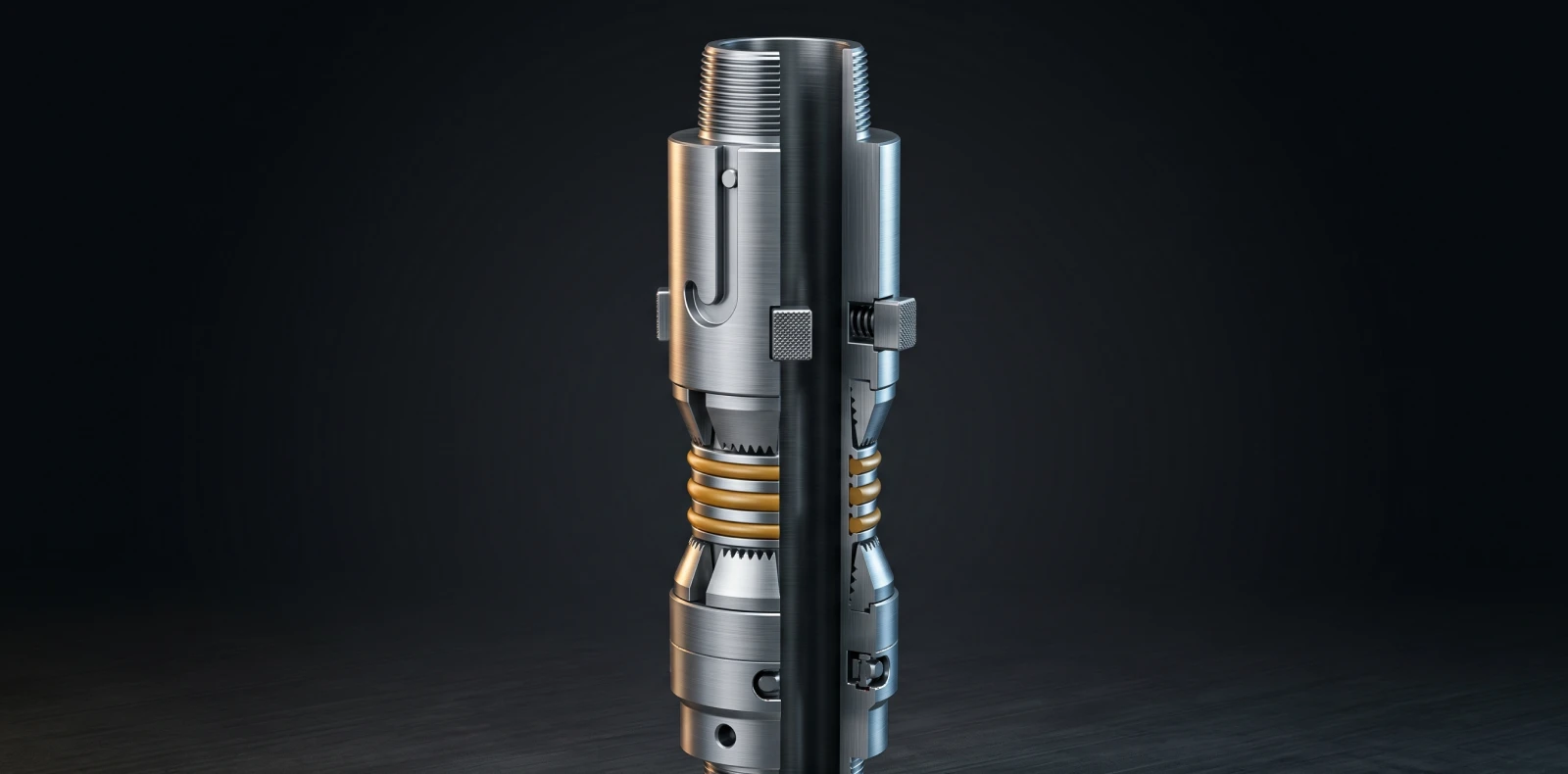
Architecturally, a DLT packer combines a compression-set primary mechanism — the seal element is energised by tubing weight after a quarter-turn rotation — with hydraulic-actuated upper hold-down buttons that anchor the tool against upward movement when high differential pressure is applied from below. Backup rings on every O-ring extend HPHT sealing life.
How the Packer SETS
| How the Packer HOLDS DOWN
|
On release, a straight pick-up on the tubing string disengages the slip mechanism, and an internal unloader/bypass equalises pressure across the seal element so the tool can be retrieved on the same trip. Positive rotational locks on the internal connections allow either left- or right-hand torque to be transmitted without disassembly, and extra-long top and bottom subs accommodate hydraulic tong make-up at surface.
Classification note: manufacturers — including Maximus OIGA — categorise the DLT under "Mechanical Set Packers" because the primary setting action is mechanical (weight plus rotation). The hydraulics serve only the secondary hold-down function. This is the source of one of the most common misconceptions about the design, addressed below.
DLT Packer Specifications and Selection Criteria
Engineers evaluating a DLT-class packer need consolidated specifications for engineering evaluation — casing size compatibility, pressure and temperature envelope, sealing materials, slip system, and the design-verification grade the tool has been qualified to.
DLT retrievable packers are typically available for 4-1/2 inch through 9-5/8 inch casing sizes with standard 2-3/8 inch EU connections. Industry-standard retrievable service packers in this class are rated to roughly 10,000–15,000 PSI differential at 300–400°F, validated against the API 11D1 / ISO 14310 design verification framework (grades V6 through V0).
[TABLE — Specifications by Casing Size | ARIA caption: DLT retrievable packer indicative specifications by casing size]
| Casing Size | Packer Max OD | Min ID | Std Connection | Indicative P/T Envelope |
|---|---|---|---|---|
| 4-1/2 in | 3.75–3.92 in | 1.75–1.88 in | 2-3/8 in EU 8 RD | 10,000 PSI @ 300°F (std) / 15,000 PSI @ 400°F (HPHT) |
| 5-1/2 in | 4.50–4.68 in | 1.88–2.00 in | 2-3/8 in EU 8 RD | 10,000 PSI @ 300°F (std) / 15,000 PSI @ 400°F (HPHT) |
| 7 in | 5.75–6.00 in | 2.25–2.44 in | 2-3/8 in or 2-7/8 in EU | 10,000 PSI @ 300°F (std) / 15,000 PSI @ 400°F (HPHT) |
| 9-5/8 in | 8.13–8.38 in | 2.81–3.00 in | 2-7/8 in or 3-1/2 in EU | 10,000 PSI @ 300°F (std) / 15,000 PSI @ 400°F (HPHT) |
Indicative ranges. Verify per-model datasheet for as-supplied ratings — actual envelope depends on casing weight, packer model variant, and elastomer selection.
Validation grades are defined by the API Specification 11D1 / ISO 14310 framework. Grades run from V6 (lowest) through V0 (highest — bubble-tight gas seal under combined axial load and temperature cycling). Quality grades run Q3 through Q1; API Q1 certification, held by Maximus OIGA, is the quality-management system behind Q1-grade qualification.
The industry HPHT envelope is conventionally defined as 15,000–20,000 PSI and 350–450°F, with Ultra-HPHT exceeding both — see the API 11D1 grade V0 qualification standard paper for the protocol. Standard DLT packers serve up to roughly 10,000 PSI at 300°F with Nitrile or HNBR elastomers; HPHT variants extend to 15,000 PSI at 400°F using FKM (Viton) or FFKM (Kalrez) and uprated metallurgy.
For context, industry retrievable-packer ratings published by Halliburton put retrievable production packers at up to 15,000 PSI at 400°F, with permanent variants reaching 20,000 PSI at 475°F. DLT-class service packers fall within the retrievable band — purpose-built for the squeeze-frac-acid-test duty cycle, not long-term production sealing.
The sealing system is typically a three-element packing stack with anti-extrusion backup rings on every O-ring. Slips are usually carbide-inserted for full-circumferential anchoring under high differential load. The internal bypass/unloader equalises pressure across the seal element on retrieval — essential to avoid swab/surge issues when the tool is pulled to surface.
Applications and Use Cases
Which type of packer fits our well conditions? For workover-grade short-duration high-pressure jobs in vertical or near-vertical wells, a DLT-class compression-set retrievable packer is typically the right tool. The hydraulic hold-down delivers the bi-directional differential-pressure tolerance these jobs require, and the compression-set primary allows straightforward setting on tubing weight without rotating equipment at depth beyond the initial quarter-turn.
Primary DLT packer applications include squeeze cementing, formation fracturing, high-pressure acidizing, inflow testing, and short-term zonal isolation during workover service. The hydraulic upper hold-down delivers the bi-directional differential pressure tolerance these jobs require, while the compression-set primary allows straightforward setting on tubing weight without rotating tools at depth.
| Application | Role of the DLT Packer | When to Choose / When Not To |
|---|---|---|
| Squeeze Cementing | Hydraulic hold-down resists the high differential pumped from above the packer during cement placement. | Choose for: remedial sealing of perforations. Avoid for: long-term production isolation. |
| Formation Fracturing | Isolates a treatment interval during workover-grade stimulation; rated for short-duration high pressure. | Choose for: small-volume frac, single-zone treatment. Avoid for: large multi-stage horizontal fracs. |
| High-Pressure Acidizing | Isolates the perforated interval while acid is pumped under backpressure; hydraulic upper hold-down anchors the tool. | Choose for: matrix acidizing, acid squeeze. Avoid for: extended-soak acid programmes where elastomer fatigue is a concern. |
| Inflow / DST Testing | Temporarily isolates an interval for productivity flow-testing during workover service. | Choose for: short-duration well testing. Avoid for: extended testing beyond the elastomer service envelope. |
| Zonal Isolation (Workover) | Short-duration zone isolation while remedial work is performed on an adjacent interval. | Choose for: workover-grade isolation. Avoid for: long-term production duty (use a double-grip production packer). |
Where the DLT-class architecture is the wrong tool — permanently sealing a producing zone, completing a deviated or horizontal well, or abandoning a wellbore — specify double-grip production packers, hydraulic-set packers, or bridge plugs instead. Sourcing the full workover-tool stack from a single specialist mechanical packer manufacturer delivers better cross-application coherence than mixing OEMs.
Need expert guidance on the right solution?
Talk to our engineers about your project requirements.
Maximus OIGA Manufacturing Authority
Maximus OIGA manufactures the SpectraMax DLT Retrievable Packer at its API Q1 and ISO 14310 certified facility in Vadodara, Gujarat. The plant operates an in-house pressure-test cell, ships every tool with full material traceability and inspection certificates, and has supplied more than 200 packer installations across India, the Middle East, and Southeast Asia.
| API Q1 Certified | ISO 14310 Compliant | ISO 9001 Quality System | 200+ Packer Installations |
The SpectraMax DLT is listed in the SpectraMax mechanical-set packer family, alongside the MaxSet IX and IXS double-grip retrievable production packers and the PAK VI hydraulic-set series rated to 15,000 PSI. Every shipment ships with Material Test Reports, inspection reports, and test certificates documenting compliance to the relevant API 11D1 / ISO 14310 grade. In-house qualification runs in a dedicated pressure-test cell against API 11D1 / ISO 14310 verification procedures — test capability behind every shipment, not third-party documentation alone.
Common Misconceptions About DLT Packers
Three misconceptions show up consistently in procurement and selection conversations. Clearing them up prevents specification errors and downstream operational surprises.
Misconception 1: "DLT means a fully mechanical-set packer with no hydraulics."
The DLT is compression-set primary plus hydraulic hold-down secondary — both mechanisms are integral. The mechanical component sets the seal element; the hydraulic component anchors the tool against upward movement when pressure is applied from below. Specifying a tool as "DLT" without the hydraulic hold-down means specifying a fundamentally different — and operationally inferior — packer for the same applications.
Misconception 2: "The hydraulic hold-down means it's a hydraulic-set packer."
It is not. In a true hydraulic-set packer — the PAK VI series, the SLB PosiTrieve hydraulic, hydraulic-set liner hangers — the seal element itself is energised by applied tubing pressure (a ball drops onto a setting seat and pressure ramps until shear pins release). In a DLT, hydraulic actuation is for hold-down only; the seal is energised mechanically by tubing weight. Selection logic, installation procedure, and failure modes all differ.
Misconception 3: "All DLT-style packers from different manufacturers are mechanically interchangeable."
While the underlying architecture is shared across licensed and equivalent designs, tolerances, elastomer specifications, slip geometry, qualification testing, and material traceability vary by manufacturer. Only the original D&L OEM and licensed or equivalent designs validated against API 11D1 / ISO 14310 will deliver the predictable HPHT performance the design is meant to deliver. Manufacturer pedigree matters — particularly for HPHT, sour-service, or critical-well applications.
Frequently Asked Questions
What is a DLT packer?
A DLT packer is a compression-set retrievable service packer with hydraulic-actuated upper hold-down. The abbreviation derives from D&L Tools — the original D&L Oil Tools design developed in Texas — and is now used as industry shorthand for the architecture itself. The seal element is energised by tubing weight applied after a quarter-turn rotation, while hydraulic hold-down buttons anchor the tool against upward movement during high-pressure operations. Maximus OIGA produces the SpectraMax DLT Retrievable Packer; multiple other suppliers manufacture licensed or equivalent designs.
What does DLT stand for in oil and gas?
DLT in well completion refers to the D&L Tools retrievable-packer design family originally developed by D&L Oil Tools in Texas. Over time the abbreviation has become industry shorthand for the compression-set, hydraulic-hold-down service-packer architecture and is now manufactured under licence and as equivalent designs by multiple suppliers.
When a buyer specifies "a DLT packer" today, they are typically specifying the design class rather than insisting on a single OEM. The term describes architecture, not a brand-locked product code.
What is the difference between a DLT retrievable packer and a hydraulic-set packer?
In a DLT (compression-set) packer, the seal element is energised by mechanical weight applied through the tubing string after a quarter-turn rotation. Hydraulic-actuated buttons serve only as an upper hold-down — they do not set the seal. In a true hydraulic-set packer such as the PAK VI series or the SLB PosiTrieve hydraulic, the seal is energised by applied tubing pressure: a ball drops onto a setting seat and pressure ramps until shear pins release. Practical selection: DLT for shallow or vertical workover where tubing manipulation is straightforward; hydraulic-set for deep, deviated, or horizontal wells where rotating or moving the string at depth is impractical.
What pressure and temperature can a DLT retrievable packer handle?
Standard-service DLT packers are typically rated 5,000–10,000 PSI differential at 250–300°F using Nitrile or HNBR elastomers. HPHT variants extend to 10,000–15,000 PSI differential at 300–400°F using FKM (Viton) or FFKM (Kalrez) elastomers with uprated metallurgy. The as-supplied envelope depends on casing weight, packer ID, model variant, and elastomer selection — always refer to the manufacturer's per-size technical data sheet. The API 11D1 / ISO 14310 framework specifies the test envelope each grade (V6 through V0) is qualified against.
What are the typical applications of a DLT retrievable packer?
Primary applications are squeeze cementing (isolating perforations to pump cement under pressure), formation fracturing and high-pressure acidizing (isolating treatment intervals during stimulation), inflow / DST testing (isolating an interval to flow-test productivity), and short-term zonal isolation during workover operations. The DLT architecture is not typically used for long-term production packing (specify a double-grip production packer such as MaxSet IX), highly deviated or horizontal wells where weight-setting is impractical (specify a hydraulic-set packer), or permanent abandonment (specify a bridge plug).
Next Steps
API Q1 certified manufacturer · 200+ installations · Ships globally
Maximus OIGA manufactures the SpectraMax DLT Retrievable Packer for the casing-size and pressure-temperature envelope described above, supplied with full material traceability and test documentation. To evaluate the SpectraMax DLT against a specific well plan, request the per-model technical data sheet — the specification package covers the as-supplied pressure-temperature envelope, sealing system, slip system, and connection details for the relevant casing programme.
Related Blogs

More Information
Related News & Insights
Best bridge plug manufacturers in Asia
Thirteen bridge plug manufacturers in Asia — China, India and the UAE — compared on seven points, across drillable, retrievable, composite and dissolvable plug types.
October 20, 2026
Best downhole tool manufacturers in Asia
Fourteen downhole tool makers in Asia — China, India, Indonesia and the UAE — compared on seven points and on which of the six completion-tool families each one builds.
October 20, 2026
API 11D1 vs ISO 14310 - what a V0 rating actually certifies
What a V0 rating really means under API 11D1 and ISO 14310 — and ten checks that take a packer or bridge plug claim from the brochure line to the validation record behind it.
October 20, 2026
Indian downhole completion tool manufacturers compared: API status, plants, catalogue and lead times
Most Indian suppliers list packers, bridge plugs and liner hangers. The harder question is who actually makes the goods, where, and what documents arrive with the order. This comparison puts six Indian downhole tool manufacturers side by side on manufacture, plant location, catalogue breadth, published lead times and the documentation pack, using only what each company publishes about itself.
September 25, 2026
Zonal isolation systems
A bridge plug, a packer, a cement retainer, a straddle packer or a stage cementing collar can each be the right way to isolate an interval in a cased well. Which one depends on where the zone sits, how long the isolation must hold, and whether cement goes through the tool. This guide maps each isolation job to its tool class and its named SpectraMax models, then covers what to specify, how each tool sets and seals, and where each option stops working. It also sets out the records that ship with the order and the lead-time bands by product class, so you can plan the run before the quotation arrives.
September 25, 2026
Casing scrapers
A packer, bridge plug or cement retainer only grips and seals on a clean casing wall, and the scraper that cleans it has to fit your casing on the way down and at depth. This guide covers how a casing scraper cleans, the three main configurations, and how to size one to your casing OD and weight range, with worked ID and drift figures for 5-1/2 in, 7 in and 9-5/8 in casing. It then matches each configuration to its well condition, sets out where every option stops working, and lists the records that should ship with the order.
September 25, 2026
Gas anchors
Low fillage, fluid pound or a gas-locked rod pump usually points to the same tool below the pump: a gas anchor. Which configuration fits depends on whether the pump can sit below the perforations, how much liquid it displaces, and whether solids or deviation are in play. This guide works through the four configurations by well condition, then covers the sizing rule, the specifications a quotation has to fix, and where each option stops working. It also sets out the records that should ship with the part and the SpectraMax lead-time bands by product class.
September 25, 2026
Coiled tubing tools
"Coiled tubing tools" covers three different things: the surface spread, the intervention bottom-hole assembly, and the completion tools coiled tubing conveys and sets. Only the third group is manufactured completion equipment, and it is the group this page is about. It covers what conveyance changes about the tool itself, which of the three families (bridge plug, cement retainer, packer) suits which job, and the six inputs a supplier needs to quote one. It also sets out where each option stops, the records to ask any supplier for, and the lead-time bands by product class.
September 21, 2026
Saudi Aramco vendor registration for completion equipment suppliers
Saudi Aramco vendor registration is a prequalification on Aramco's e-Marketplace that ends in a Vendor ID, and being registered is not the same as being qualified. This guide walks the out-of-Kingdom route for a completion equipment manufacturer: how Aramco weighs financial strength, technical qualification and IKTVA local content, and which documents an international supplier actually files instead of the Saudi statutory set. It also sets out what a manufacturer can carry for your submission, what stays with you, and the records to ask any supplier for before a purchase order.
September 21, 2026
ONGC vendor registration for downhole tool suppliers: the actual sequence
Selling downhole tools to ONGC starts with a commercial gate, not the technical bid: you complete supplier self-registration on ONGC e-Procurement, get a bidder User-ID, then finish vendor enlistment before you can bid on a single tender. This guide walks the actual sequence, the documents an Indian or overseas applicant submits, how ONGC weighs a bid once local content is applied, and a realistic timeline. It is honest about what a manufacturer can and cannot do for your bid, and what to ask any supplier for in writing.
September 21, 2026