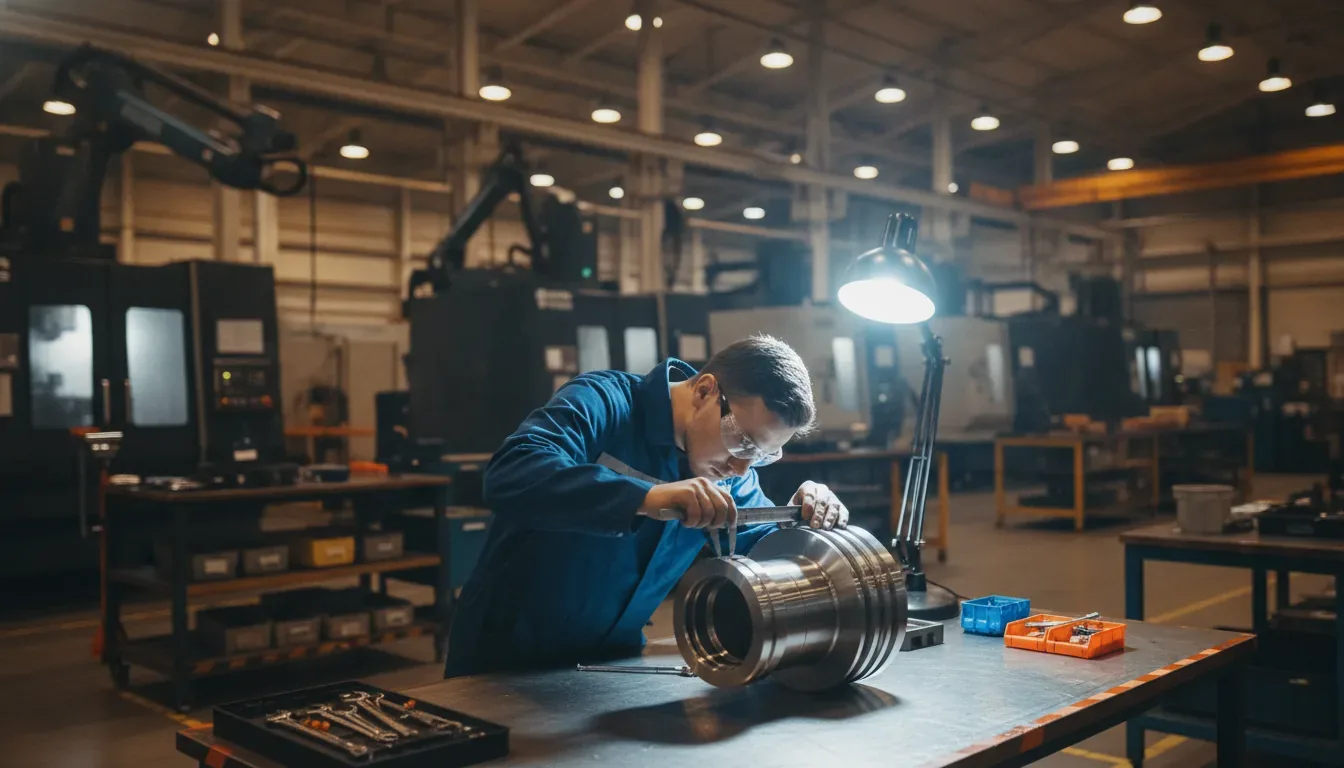
Zonal isolation systems
Zonal Isolation Systems
SpectraMax Zonal Isolation Packers and Plugs, Engineered to Order
SpectraMax packers, bridge plugs, cement retainers and stage cementing collars isolate one interval of a cased well from the next, permanently or for a treatment or test. Each is built to your well at the Manjusar / Savli GIDC plant, Vadodara.
What is zonal isolation, and which part of it do these tools do
| Zonal isolation is keeping the fluids of one zone of a well (water, gas or oil) out of another zone, by a hydraulic seal between casing, cement and formation or by a mechanical element set against the casing. Cement is the first barrier in the annulus; the SpectraMax tools here do the mechanical side in a cased well. |
Each tool class does one isolation job:
- A bridge plug seals off the wellbore below it.
- A packer isolates the production conduit from the annulus.
- A cement retainer lets you squeeze cement into a lower interval while the annulus above stays isolated.
- A straddle packer isolates one interval between two others so it can be treated on its own.
- A stage cementing collar places cement in two stages over a weak zone.
Each class carries named SpectraMax models, one card per class below.
Which isolation tools are in the SpectraMax line
The SpectraMax zonal isolation family has six tool classes: production and isolation packers, permanent bridge plugs, retrievable bridge plugs, cement retainers, straddle and selective treating packers, and stage cementing collars.
Card 1: Production and isolation packers (zonal isolation packers)
The job it does: Seals the annulus so one zone produces or takes injection while the other zones stay isolated.
SpectraMax models: SpectraMax Permanent Hydraulic Isolation Packer, SpectraMax Pak-I, Pak-VI, MFH, SpectraMax Set IXS Injection Packer, Set IX, DLT
About the models: The Permanent Hydraulic Isolation Packer is a hydraulic set permanent production packer with a large ID, centralizing slips for deviated sections and built-in setting equipment for tubing or casing pressure. The Set IXS is a large bore, double grip retrievable packer for injection and zone isolation that holds pressure from above and below. The Pak-I suits multi zone and deviated wells: packers run in tandem with adjustable setting pressures and set selectively using a temporary plug below the bottom packer.
Choose it when: You need to produce or inject through tubing with the annulus sealed.
Card 2: Permanent bridge plugs
The job it does: Shuts off the wellbore below the plug for good.
SpectraMax models: SpectraMax WBP Wireline Set Bridge Plug, SpectraMax HM Tubing Set Bridge Plug
About the models: Both are cast iron and drillable. The WBP is set on wireline; the HM is set on the tubing string.
Choose it when: A zone below is depleted or watered out and you do not plan to return to it.
Card 3: Retrievable bridge plugs
The job it does: Holds the zone below isolated for a treatment or test, then comes back out.
SpectraMax models: SpectraMax MSU Retrievable Bridge Plug, WRP Retrievable Bridge Plug
About the models: The MSU is built for multiple selective zone treating and testing. The WRP gives temporary well isolation and seals in both directions.
Choose it when: You are treating or testing an upper zone and need the lower zone back afterward.
Card 4: Cement retainers
The job it does: Lets a squeeze be pumped into a lower interval while the annulus above stays isolated.
SpectraMax models: SpectraMax PCR Mechanical Set Cement Retainer
About the model: Used for cement squeeze work and suitable for both single and dual stage cementing.
Choose it when: You need to squeeze cement into perforations or a leak below the tool.
Card 5: Straddle and selective treating packers
The job it does: Isolates one interval between two others so it can be treated or tested alone.
SpectraMax models: SpectraMax Pinpoint Injection (PPI) Packer, SpectraMax MSTA Selective Treating Assembly
About the models: The PPI is a retrievable treating straddle packer with 1 ft spacing between its elements, and the spacing can be changed to suit the job. The MSTA isolates intervals from 12 in up to any length using pup joints.
Choose it when: One interval needs treating and the zones above and below must stay untouched.
Card 6: Stage cementing collars
The job it does: Places cement in two stages, so the upper casing section is cemented after the lower one.
SpectraMax models: MDV Mechanical Stage Cementing Collar, MDVX Hydraulic Stage Cementing Collar
About the models: The MDVX opens hydraulically and is drillable with a PDC bit. The MDV gives positive containment of cement, and all its internal parts are drillable.
Choose it when: A single long cement column would break down a weak or lost-circulation zone.
Which class fits depends on your well condition, and the table below maps each isolation job to its tool.
Which isolation tool suits your well condition
The right zonal isolation tool depends on three questions about your well: where the zone to isolate sits relative to the tubing and the other zones, how long the isolation must last (the life of the well, or one treatment or test), and whether cement has to be placed through the tool.
| Isolation job | Tool class | SpectraMax models | Choose it when | Where it stops |
| Shut off a depleted or watered-out zone below, for good | Cast iron bridge plug | SpectraMax WBP (wireline set), SpectraMax HM (tubing set) | You will not return to the zone; the plug is usually capped with cement | It is permanent: regaining the zone means drilling it out |
| Isolate the zone below while an upper zone is treated or tested | Retrievable bridge plug (temporary isolation) | SpectraMax MSU, WRP | You need the lower zone back after the job | It has to come back out, so sand and debris above it need managing |
| Squeeze cement into perforations or a leak below, with the annulus above protected | Cement retainer | SpectraMax PCR (mechanical set) | Remedial squeeze cementing in a workover | The stinger and valve assembly must suit the squeeze pressures on the quotation |
| Produce or inject from one zone with the annulus and other zones isolated | Production packer or isolation packer | Hydraulic set: Permanent Hydraulic Isolation Packer, Pak-I, Pak-VI, MFH. Mechanical set: Set IX, Set IXS, DLT | Hydraulic set in a deviated well or where the wellhead is already flanged up; mechanical set where the string can be rotated or set down | Permanent packers are milled out; retrievable packers are released |
| Treat or test one interval between two others | Straddle packer or selective treating assembly | SpectraMax PPI, MSTA | The interval length is known before the run | Element spacing is fixed to the interval before running in |
| Place a long cement column over a weak or lost-circulation zone | Stage cementing collar | MDV (mechanical), MDVX (hydraulic) | A one-stage job would break down the weak zone | The collar is drilled out after the second stage |
| Isolate an open-hole section with no casing to set against | Open-hole barrier, such as a swellable packer | None in this cased-hole family | Only where the hole has no casing for slips to grip | Outside this page's scope; the boundaries section below lists it |
Tool-class roles follow the industry glossary definitions listed in the sources at the end of this page. SpectraMax model descriptions are taken from the SpectraMax product pages, checked September 25, 2026.
Once you have the tool class, the quotation is built from the specification below.
Button: Compare the family and request a quotation
Tell us the job, your casing size and weight, the setting depth and how long the isolation must last.
What do you need to specify for a zonal isolation packer, plug or retainer
A zonal isolation tool is specified by the casing it sets in (OD, weight and grade), the setting depth, the differential pressure it must hold and from which side, the bottomhole temperature, the well fluids, the setting method, and whether it must come back out.
Box 1, Casing OD and weight: Casing OD and casing weight set the casing ID the slips and element must grip and seal, and the drift the tool must pass on the way down.
Box 2, Casing grade: The casing grade decides how the slips bite without damaging the casing; high-strength casing changes the slip design.
Box 3, Setting depth: The setting depth tells us where the tool sits in the well and the conditions it will see there.
Box 4, Differential pressure and direction: The differential pressure and the side it comes from decide between a single-grip and a double-grip tool; the SpectraMax Set IX and Set IXS hold pressure from above and below.
Box 5, Temperature: The bottomhole temperature, with the well fluids, decides the elastomer compound and the metallurgy.
Box 6, Well fluids: H2S and CO2 change the element compound and the metallurgy. SpectraMax service packers are offered with Nitrile, HNBR, HSN, Viton and Aflas elements.
Box 7, Setting method: Hydraulic set suits deviated holes and flanged-up wellheads, mechanical set needs rotation or set-down weight, and wireline set suits a plug run without a rig string.
Box 8, Retrieval plan: If you plan to retrieve the tool, it must be built to release and pull; a permanent tool is drilled or milled out.
The quotation states the pressure and temperature envelope for the exact tool quoted, with the test evidence behind it.
How the tool sets and seals follows from the setting method you pick.
How does each isolation tool set and seal
A packer, bridge plug or cement retainer sets and seals by pushing slips outward to grip the casing wall and compressing an elastomer element until it seals against the casing, using tubing pressure (hydraulic set), string rotation or set-down weight (mechanical set), a wireline setting tool, or the tubing string itself.
On a packer, that seal isolates the annulus from the production conduit. The slips and the element are carried on the mandrel, and the setting method decides how the setting force reaches them. A cement retainer adds a valve: a stinger engages the retainer for the squeeze, and when the stinger is pulled, the valve closes and isolates the wellbore below.
Box 1, Hydraulic set: Tubing or casing pressure actuates built-in setting equipment, with no string manipulation. SpectraMax example: Permanent Hydraulic Isolation Packer.
Box 2, Mechanical set: Rotation, tension or set-down compression on the string sets the tool; the Set IX sets shallow with tension or deeper with compression. SpectraMax example: Set IX.
Box 3, Wireline set: A wireline setting tool runs and sets the plug without a rig string. SpectraMax example: WBP Wireline Set Bridge Plug.
Box 4, Tubing set: The plug is run and set on the tubing string. SpectraMax example: HM Tubing Set Bridge Plug.
Which setting method a job calls for depends on where in the life of the well the tool goes in.
Where in the life of a well is each isolation tool used
Zonal isolation tools are used at five points in a well's life: stage cementing collars during construction, production and isolation packers at completion, retrievable bridge plugs and straddle packers for stimulation and testing, cement retainers for remedial squeezes, and cast iron bridge plugs to shut off a zone or at abandonment.
Step 1, Construction: During well construction, a stage cementing collar (MDV or MDVX) lets the upper casing section be cemented after the lower one.
Step 2, Completion: At completion, a production packer is run with the tubing to isolate the annulus for production or injection. SpectraMax tool: Permanent Hydraulic Isolation Packer.
Step 3, Stimulation and testing: For stimulation and well testing, a retrievable bridge plug isolates the zone below and a straddle packer isolates the interval being treated. SpectraMax tools: MSU and PPI.
Step 4, Remediation: In a workover, a cement retainer holds the annulus above while a squeeze is pumped for remedial cementing. SpectraMax tool: PCR.
Step 5, Abandonment: A cast iron bridge plug shuts off a zone for good and forms part of plug and abandonment. SpectraMax tools: WBP and HM.
At each of these points, the quotation defines the tool by the same set of specifications.
What specifications define a SpectraMax isolation tool
Each SpectraMax zonal isolation tool is defined on the quotation by the casing size and weight range it fits, its gauge OD and bore (ID), its setting method, its element compound, its metallurgy and end connections, and the pressure and temperature envelope the plant states for that exact build.
SpectraMax tools come in multiple sizes for different casing configurations and are built to the casing size and weight range on your enquiry. Element compounds are Nitrile, HNBR, HSN, Viton and Aflas, quoted per tool. The SpectraMax Pak-I can be built with modified metallurgical and elastomeric properties for the well environment. Cast iron bridge plugs and cement retainers have cast iron bodies and are drillable.
| Parameter | What you tell us | What the quotation confirms |
| Casing size and weight range | Casing OD, weight (lb/ft) and grade | The size and weight range the tool fits |
| Gauge OD and bore | Casing drift and the bore you need for flow or access | Gauge OD and bore (ID) of the tool as built |
| Setting method | Rig string, wireline or tubing; hole deviation; wellhead status | Hydraulic, mechanical, wireline or tubing set |
| Element compound | Bottomhole temperature and well fluids | Nitrile, HNBR, HSN, Viton or Aflas |
| Metallurgy (including sour service) | H2S and CO2 content | Body and slip material; cast iron for drillable plugs and retainers |
| End connections | Tubing or casing thread | End connection type and size |
| Pressure and temperature envelope | Differential pressure, its direction, and temperature | Stated on the quotation for the exact size, element and metallurgy, with its test evidence |
| Documentation required | Your QA requirements | The documentation pack listed below, including the material test report |
Every one of these choices also sets where the tool stops working.
Need expert guidance on the right solution?
Talk to our engineers about your project requirements.
Where does each isolation option stop working, and what does a failure cost
Every zonal isolation tool stops working when its element is used outside the temperature and fluids it was compounded for, when the pressure reverses on a tool built to hold from one side, when its slips cannot grip the casing it was set in, or when it is left in the well longer or retrieved later than it was designed for.
- An element outside its temperature and fluids
- A pressure reversal on a tool built to hold from one side
- Slips that cannot grip the casing
- A tool left in too long or retrieved late
Panel 1, Packer and plug elements: An elastomer element stops sealing when temperature or well fluids exceed what its compound was chosen for: it hardens, swells or extrudes, and the seal starts to leak. That is why the element compound sits in the specification.
Panel 2, Single-grip tools: A single-grip tool fails when the differential reverses and it was not built to hold from that side. Double-grip designs such as the SpectraMax Set IX hold pressure from above and below.
Panel 3, Retrievable bridge plugs: A retrievable bridge plug gets stuck when sand or debris settles on top of it or it stays in the well longer than planned, and then it will not release. The MSU's large internal bypass prevents swabbing on the way in; debris on the way out is a matter of planning the job.
Panel 4, Cast iron bridge plugs: A cast iron bridge plug is permanent, and that is its limit: regaining the zone below means drilling it out.
Panel 5, Mechanical set packers: A mechanical set packer stops working where the hole is too crooked or deviated to transmit rotation or set-down weight. Hydraulic set tools such as the SpectraMax MFH are built for those wells.
Panel 6, Cement retainers and stage cementing collars: A cement retainer relies on its stinger and valve assembly, which must suit the squeeze pressures on the quotation. A stage cementing collar is drilled out after the second stage, so its internal parts are drillable by design.
These limits are set by the well and the specification, and the next question is what changes when the tools come from a specialist manufacturer.
Do you lose anything by buying isolation tools from a specialist manufacturer
Buying zonal isolation tools from a specialist manufacturer changes who runs the job: the tools, their documentation and their lead time come from the plant, while the setting crew, the wireline unit and the cementing service come from your own team or service company.
| Integrated service company | Specialist manufacturer | |
| Tool supply | The tool, often as a proprietary branded system | The SpectraMax tool, built to your enquiry |
| Running the job | The company's own crew runs it under the same contract | Your team or your service company runs it with its own setting crew and wireline unit; Maximus OIGA Private Limited supplies no rig-site crew |
| Documentation and lead time | Set within the service contract | A documentation pack with each order and a published lead-time band |
| What you give up is the integrated bundle: one contract covering the tool and the crew that runs it. Your team or service company will run the job with standard setting tools, so the tool itself is not tied to one company's system. |
Conventional cased-hole packers, bridge plugs and cement retainers are run with standard setting tools on tubing or wireline, and the setting-tool interface is confirmed on each quotation.
What stays the same with any supplier is the set of standards you can hold it to.
Which standards apply to isolation packers and plugs, and how do you verify a vendor's claims
Packers and bridge plugs are governed by ISO 14310 (Petroleum and natural gas industries, Downhole equipment, Packers and bridge plugs), with API 11D1 as its API counterpart; both define design validation grades from V6 up to V0, the gas-tight grade, and quality control grades, and both are claimed per product and size, not per company.
V6 is the basic grade and V0 the most demanding, so a lower number means a more severe test. A validation grade certifies one product design and size, tested to that grade and backed by a test report; it is not a company-wide rating. A test report on the seal is a different document from a material test report, which traces the steel. The current edition is ISO 14310:2008, and a revision is in preparation. API Standard 65-2, Isolating Potential Flow Zones During Well Construction, covers the practice of isolating flow zones while the well is built.
| Document | What it covers | What to ask the vendor for |
| ISO 14310 | Design validation grades and quality control grades for packers and bridge plugs | The validation test report for the exact model and size, with its grade and date |
| API 11D1 | The API document for packers and bridge plugs, parallel to ISO 14310 | The same test report, plus the licence number behind any API licence the vendor quotes |
| API Standard 65-2 | Isolating potential flow zones during well construction | Nothing from the vendor: it guides the operator's barrier plan, and the tool specification follows that plan |
To verify any vendor's claims, use these four steps:
1. Ask for the validation test report for the exact model and size you are buying.
2. Read the grade and the test date on the report. A grade stated with no report is a claim, not evidence.
3. Search the vendor's exact legal name on the API Composite List at mycerts.api.org, the public register of API licences, then read the status (only an Active status is current) and the specification scope it covers.
4. Record the date you checked, and apply the same four steps to every vendor on your shortlist, including Maximus OIGA Private Limited.
The documents that travel with each order are the other half of the check.
What documentation ships with a SpectraMax isolation tool
Each SpectraMax zonal isolation tool order ships with a dimensional drawing with gauge OD and bore, a material test report (MTR) traceable to heat numbers, the element compound certificate, the plant pressure and function test record for the tool as built, and a certificate of conformity to the purchase order specification.
An inspection and test plan (ITP) is issued when your QA requires one. The plant pressure test is the isolation test engineers ask about: it proves that this tool, as built, held the test pressure recorded on the report at the plant. It is not a validation grade, and the two documents answer different questions.
Box 1, Drawing: Dimensional drawing with gauge OD and bore.
Box 2, MTR with heat numbers: Material test report traceable to the heat numbers of the steel.
Box 3, Element compound certificate: The compound of the element fitted to your tool.
Box 4, Pressure and function test record: The plant test on the tool as built, with the pressure held.
Box 5, Certificate of conformity: Conformity to the specification on your purchase order.
The documentation pack ships with the tool, so the lead time below covers the paperwork as well.
What is the lead time for SpectraMax isolation tools
SpectraMax lead-time bands by product class are 1 to 4 weeks, 4 to 12 weeks, and 8 to 16 weeks or more. Standard-size cast iron bridge plugs and cement retainers sit in the 1 to 4 week band; packers, retrievable bridge plugs, straddle packers and stage collars sit in the 4 to 12 week band; non-standard sizes, special element compounds and sour-service metallurgy sit in the 8 to 16 week or more band.
Cell 1, 1 to 4 weeks: Standard-size cast iron bridge plugs and cement retainers
Cell 2, 4 to 12 weeks: Packers, retrievable bridge plugs, straddle packers and stage cementing collars
Cell 3, 8 to 16+ weeks: Non-standard sizes, special element compounds and sour-service metallurgy
Each tool is engineered to order, and Maximus OIGA Private Limited states the lead-time band for your build on the quotation. None of the zonal isolation product pages we checked on September 25, 2026 publishes a lead time.
The bands cover the tools in this family; the next section lists what falls outside it.
What does this page not cover
Maximus OIGA Private Limited does not supply cement slurries, cementing or wireline services, rig-site crews, inflatable packers, external casing packers or expandable-metal barriers for zonal isolation; it manufactures the SpectraMax tools in this family and ships them with their documentation.
This page does not cover, and we do not supply:
- Cement slurry, cementing services or wireline services.
- Rig-site crews to run or set the tools. Your team or service company runs the job.
- Inflatable packers, external casing packers and expandable-metal barriers, including the proprietary open hole systems some service companies sell under their own names.
- The choice between cementing and mechanical isolation methods, which a separate methods guide on this site covers. This page starts once the mechanical tool class is the question.
- Positive isolation or mechanical isolation of process piping: isolating plant pipework and equipment for maintenance with blinds, spades and lockout. That process isolation is a different subject from downhole zonal isolation.
Ratings and credentials are handled the same way for every tool on this page: the quotation states the pressure and temperature envelope for the exact build with its test record, and the standards section above shows how to check any vendor's licence on the public register.
That leaves the questions engineers still ask once the tool class is settled.
Zonal isolation packer and plug questions engineers ask
What is a zonal isolation packer?
A zonal isolation packer is a packer set in the casing to seal the annulus, so one zone is isolated from the others while the well produces or takes injection through the tubing. Zonal isolation packers come in hydraulic set and mechanical set designs; SpectraMax examples are the Permanent Hydraulic Isolation Packer and the Set IXS injection and zone isolation packer. In open hole, where there is no casing to grip, a swellable packer, often called a swell packer, seals by swelling instead.
How is a packer's isolation tested before it goes in the well?
Each SpectraMax tool is pressure and function tested at the plant as built, and the result is recorded on its test record. That isolation test is different from a validation grade, which is a design test on the model and size, so ask any vendor for both documents.
Which isolation tool works in a deviated well?
A hydraulic set packer works in a deviated well because it sets with tubing pressure, without string rotation or set-down weight. The SpectraMax MFH is built for multi zone production where crooked or deviated holes are unsuitable for mechanical packers, and the Permanent Hydraulic Isolation Packer carries centralizing slips for deviated sections.
If I buy isolation tools from a specialist manufacturer, do I lose the integrated bundle?
You give up one contract that covers the tool and the crew together. Maximus OIGA Private Limited supplies the SpectraMax tool, its documentation and a published lead-time band, and your team or service company runs it with standard setting equipment.
What should a zonal isolation tool quotation specify?
A quotation for a packer, bridge plug or cement retainer should specify the isolation job, casing OD, weight and grade, setting depth, differential pressure and its direction, temperature, well fluids, setting method, retrieval plan, and the documentation you need.
Related Blogs

More Information
Related News & Insights
Casing scrapers
A casing scraper cleans cement, scale and perforation burrs off the casing wall so a packer, bridge plug or cement retainer sets and seals. This page covers the three types, how to size one to your casing weight range, what a quote needs, and where each type stops working. Maximus OIGA Private Limited builds the SpectraMax Casing Scraper (MCS) to order at its Manjusar / Savli plant in Vadodara. Lead time runs 1 to 4 weeks for a standard blade-block scraper and 4 to 12 weeks for a non-rotating or non-standard size.
September 25, 2026
Gas anchors
A gas anchor separates free gas from well fluid below a sucker-rod pump, so the pump fills with liquid instead of gas locking. This page covers the four types, how to size one against your pump rate, what a quote needs from you, and where each type stops working. Maximus OIGA Private Limited builds SpectraMax gas anchors to order at its Manjusar / Savli plant in Vadodara. Lead time runs 1 to 4 weeks for dip-tube and collar-size anchors, and 4 to 12 weeks for packer-type separators.
September 25, 2026
Coiled tubing tools
Coiled tubing tools fall into three groups, and this guide covers the completion tools coiled tubing sets: bridge plugs, cement retainers and packers. It explains how coiled tubing changes reach and setting force, how to choose between the three, and the six details a quote needs. Maximus OIGA Private Limited builds these SpectraMax tools to order at its Manjusar / Savli plant in Vadodara but does not supply the coiled tubing or run the job. SpectraMax lead time bands run 1 to 4, 4 to 12, and 8 to 16 weeks or more by product class.
September 21, 2026
Saudi Aramco vendor registration for completion equipment suppliers
Saudi Aramco vendor registration ends in a Vendor ID, and a maker based in India applies through Aramco Asia. This guide covers the papers each route needs, how suppliers are scored, and why registered is not the same as qualified. It also shows what a maker can add to your file, and why it cannot get a Vendor ID for you. Maximus OIGA Private Limited makes the SpectraMax line at its Manjusar / Savli plant in Vadodara and is not a registered Aramco vendor.
September 21, 2026
ONGC vendor registration for downhole tool suppliers: the actual sequence
To sell downhole tools to ONGC, a supplier first needs a bidder User-ID, a Class III digital signature and a place on the approved vendor list. This guide covers the documents ONGC asks for, how it scores a bid, the local content rules and a realistic timeline. It also shows what a manufacturer can add through its paperwork, and why it cannot enlist or bid for you. Maximus OIGA Private Limited builds its SpectraMax completion tools to order at its Manjusar / Savli plant in Vadodara.
September 21, 2026

ADNOC ICV certification: what a completion-tool supplier actually needs
No ADNOC ICV certificate means a 0% In-Country Value score at tender award. This guide explains how a MoIAT-approved body scores your audited accounts, what documents you need, and why you renew each year. It also shows why an overseas maker cannot hold the certificate for you, and what its paperwork can add. Maximus OIGA Private Limited builds the SpectraMax line to order at its Manjusar / Savli plant in Vadodara and ships each order with that paperwork.
September 21, 2026
Best drillable bridge plug manufacturers supplying US land operators
Shortlisting drillable bridge plug manufacturers supplying US land operators starts with checks you can run yourself. This guide shows how to check a maker's licence on the API Composite List and how US operators vet a new supplier. Maximus OIGA Private Limited ships SpectraMax cast iron bridge plugs from its Manjusar / Savli plant in Vadodara and has no US office, agent or distributor. SpectraMax lead time bands run 1 to 4, 4 to 12, and 8 to 16 weeks or more by product class.
September 17, 2026
Liner Hanger Manufacturers Supplying UAE Operators
Shortlisting liner hanger manufacturers supplying UAE operators starts with checks you can run yourself. This guide shows how to check a maker's licence on the API Composite List and how ADNOC ICV and vendor registration work. Maximus OIGA Private Limited ships SpectraMax liner hangers from its Manjusar / Savli plant in Vadodara and has no office or agent in the UAE. SpectraMax lead time bands run 1 to 4, 4 to 12, and 8 to 16 weeks or more by product class.
September 17, 2026
Best oilfield equipment manufacturers supplying Qatar
Oilfield equipment manufacturers supplying Qatar face three gates: QatarEnergy registration, a Tawteen ICV score, and import checks for regulated goods. This guide explains each gate and how to check any vendor's licence on the API Composite List. Maximus OIGA Private Limited ships its SpectraMax line from its Manjusar / Savli plant in Vadodara and has no office or agent in Qatar. SpectraMax lead time bands run 1 to 4, 4 to 12, and 8 to 16 weeks or more by product class.
September 17, 2026