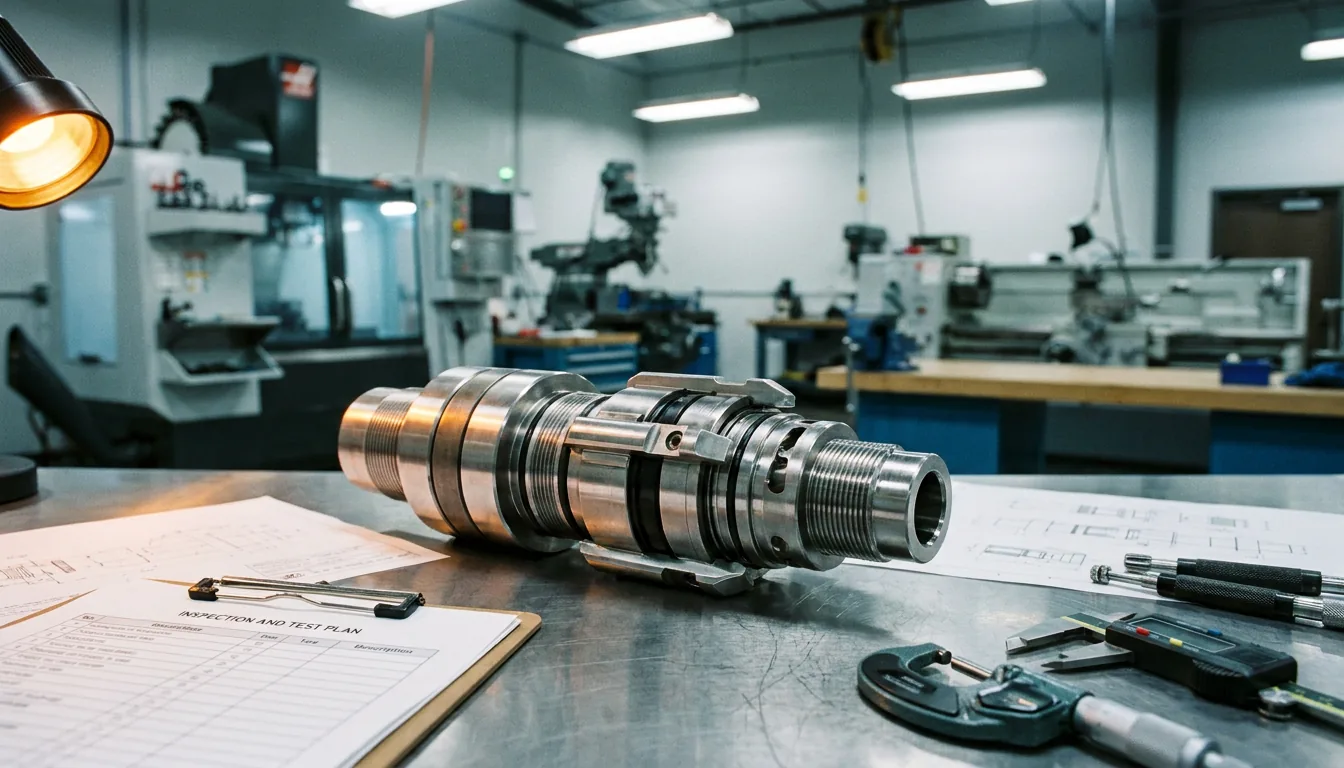
Shell and BP Supplier Qualification for Completion Equipment
Published:
Shell and BP both pick suppliers through SAP Ariba sourcing events, after assessing financial position, technical capability and the ability to deliver safely. Qualification starts with the buyer's invitation, so equipment manufacturers should have their records ready before it arrives and register second.
Shell and BP select and invite suppliers to sourcing events on SAP Ariba, after assessing financial position, technical capability and ability to deliver safely. Both companies state these criteria on their own supplier pages.
Supplier qualification at either one starts with the buyer's selection, so an equipment manufacturer prepares its evidence first and registers second. The short answer is to have the records ready before an invitation arrives, and the detail runs in the order a manufacturer meets it: each company's route, the platforms that can appear, the technical and HSSE checks, the documents to hold and the timing.
Shell and BP supplier qualification in brief: what do you need to know
Shell and BP qualify equipment suppliers by inviting selected suppliers into a SAP Ariba sourcing event, where questionnaires and assessments run and registration is free.
- Both companies work by invitation, and neither describes a public sign-up route on its supplier pages.
- Shell runs ethics and compliance, financial risk, HSSE (health, safety, security and environment) and worker welfare assessments, and its HSSE assessment method varies by business unit.
- BP lists eight supplier expectations and runs a second route, Fairmarkit RFQs, which needs no registration.
- External platforms such as ISNetworld and Magnet JQS can appear, depending on the business unit.
- There is no published processing time at either company, so each sourcing event sets its own deadlines.
How does qualification with an international oil company differ from registering with a national oil company
Shell and BP invite selected suppliers into individual sourcing events, whereas a national oil company registry such as Petrobras's is an open registry that issues a certificate. Shell and BP are each an international oil company (IOC), and Petrobras is a national oil company (NOC).
The first difference is the way in. Shell and BP choose a supplier first and then send an invitation by email, while Petrobras's Petronect portal accepts registration at any time and issues a full or partial Registration Certificate (CRC).
The second is what the supplier holds afterwards. At Shell and BP it is a place in a sourcing event on SAP Ariba, with the assessments run inside it. The third is where the assessment sits: inside the event and varying by business unit at Shell and BP, against a fixed criteria set at a registry.
| Question | Shell and BP | A national registry such as Petrobras's |
|---|---|---|
| How does a supplier get in? | The buyer selects the supplier and sends an invitation by email | The supplier registers on the Petronect portal, which stays open |
| What does the supplier hold afterwards? | A place in a sourcing event on SAP Ariba | A full or partial Registration Certificate (CRC) |
| Where do the assessments sit? | Inside the sourcing event, set by the business unit and the work | Within the registry's own fixed criteria set |
| What changes by business or contract? | The business unit, the country and the work can change the HSSE method and the platform | Other national oil company registries vary by country and company |
No published comparison ranks the two models by difficulty, so a manufacturer should not assume that one is harder. How demanding either is depends on the buyer, the business unit, the country and the contract, and Petrobras is one example, not the rule. The clearest way to see the difference is to follow how Shell runs its own process.
How does Shell qualify a supplier, step by step
Shell qualifies a supplier through a selection step, an invitation to SAP Ariba, a sourcing event with assessment questionnaires, an evaluation and a contract. What searchers call Shell supplier registration or Shell vendor registration is this same sequence. Shell's own five-step process flow, with the questionnaire treated as a separate stage, runs as follows.
- Expect selection first. A Shell Contracting & Procurement (CP) Data representative evaluates and selects a supplier with the intent to invite it to an upcoming sourcing event.
- Open the invitation email. It asks the supplier to create a SAP Ariba account, or log in, for SAP Ariba Proposals and Questionnaires. Registration has no fee, and the invitation link is time limited: Shell's FAQ gives 72 hours.
- Complete the Shell Supplier Profile Questionnaire. The supplier confirms that it accepts the Shell General Business Principles, the Shell Code of Conduct and the Shell Supplier Principles, keeps its own company data in the questionnaire current and, where a financial risk assessment applies, provides its most recent financial statements.
- Take part in the sourcing event. Documents are submitted online, and the assessment questionnaires cover ethics and compliance, financial risk, health, safety, environmental and social performance, and worker welfare and labour rights.
- Wait for the evaluation. Shell evaluates the response against criteria set in advance, including cost, technical capability, ethics and compliance and local content, and then notifies the supplier of the award.
- Sign the contract through DocuSign once Shell confirms the award.
Shell's earlier name for this system was the Supplier Qualification System (SQS), and older guides still use it. Shell's current supplier pages describe the Supplier Profile Questionnaire on SAP Ariba instead, and they describe no route for an unsolicited application, so a manufacturer waits for selection. BP raises the same questions, with a second route added.
How does BP qualify a supplier, step by step
BP runs two sourcing routes: SAP Ariba Proposals and Questionnaires for RFP and RFQ events, and Fairmarkit for RFQs, which needs no registration. Searches for BP supplier registration and BP vendor registration lead to these two routes, and both start with an invitation.
Route 1, SAP Ariba Proposals and Questionnaires:
- Expect selection first. BP evaluates suppliers against set criteria and invites the selected ones to sourcing events.
- Accept the registration invitation if the company is not yet a BP bidder contact. It leads to a standard SAP Ariba account, new or existing, and registration is free.
- Watch for the event invitation by email. BP sends it to the contacts listed in the supplier's SAP Ariba account.
- Complete the proposal and questionnaire under the "BP INTERNATIONAL" tab, and keep all communication on the message board.
- Read the award notice on the message board. BP signs contracts through DocuSign.
Route 2, Fairmarkit RFQs:
- Look for the invitation email.
- Respond through the link, with supporting documents, before the deadline. No registration is required, and an optional portal lets the supplier track requests.
- Treat the award status as information. Fairmarkit shows it, but it is not a binding commitment.
- Wait for a purchase order or contract through SAP Ariba or SAP, which is the only binding commitment.
BP supplier expectations are drawn from the BP code of conduct and cover eight areas: ethics and compliance; health, safety and environment; financial crime and regulatory compliance; sustainability; human rights and modern slavery; non-discrimination and harassment; data privacy, cyber security and intellectual assets; and speak up. Suppliers pass them on to their workers, subcontractors, agents and partners. BP's supplier pages name no technical standard, pre-qualification step or audit requirement, so those come with the enquiry or from the business unit.
In its US pipelines business BP also uses ISNetworld to track contractor tasks, one of several platforms that can sit behind either company's process.
Which qualification platforms can appear in a Shell or BP assessment
Shell names Avetta, ISNetworld, Magnet JQS and SEQual as external platforms its business units may use to assess HSSE capability. It gives them as examples, and the business unit chooses the method by the nature and risk of the work and the country.
BP's published pages name SAP Ariba and Fairmarkit for sourcing, and ISNetworld in its US pipelines business. Neither company's supplier pages name Achilles, although third-party guides sometimes describe it as a system the two companies share.
| Platform | What the source says | Named by Shell or BP |
|---|---|---|
| Avetta | Listed by Shell as an example of an external HSSE platform | Shell |
| ISNetworld | Listed by Shell as an example; BP uses it to track contractor tasks in its US pipelines business | Shell, and BP in US pipelines |
| Magnet JQS | Listed by Shell as an example. Described as a joint qualification system used by operators in Norway; Equinor and Aker BP (a different company from BP) name it | Shell |
| SEQual | Listed by Shell as an example of an external HSSE platform | Shell |
| Achilles JQS and FPAL | Described by Achilles as pre-qualification communities for Nordic and UK oil and gas buyers, combined as the Oil and Gas Europe network | Neither |
Whether a Shell or BP business unit asks for one of these platforms depends on the unit and the work. A manufacturer that receives a platform request should ask the buyer which platform applies before paying for membership of any, because these external supplier qualification platforms sit apart from the free SAP Ariba registration. Whichever platform appears, the technical assessment is where an equipment manufacturer's own records come in.
What does the technical assessment look at for completion equipment
Shell and BP assess technical capability as the ability to deliver in line with the company's own standards, judged in the selection step and again in the evaluation of the bid. A manufacturer answers with test records tied to the purchase specification and runs a check at source on any certificate it cites.
Neither company publishes the standards a tool must meet on its supplier pages. The standards sit in the enquiry or the purchase specification, which names the product standard, the quality-system requirement and the test grades the buyer wants. The manufacturer asks which apply and answers against them with records.
For a completion tool, a technical reviewer reasonably looks at five things: quality-system evidence, the manufacturing and inspection plan, material traceability, pressure and function test evidence, and the plant and test facility. The question behind each is whether the supplier can deliver in line with the company's standards.
| What a reviewer checks | The record that answers it |
|---|---|
| Quality-system evidence | Quality manual and quality policy, plus any quality-system certificate the buyer names, checked at the body that issued it |
| Manufacturing and inspection plan | An inspection and test plan (ITP) for the tool, with a sample ITP as the starting document |
| Material traceability | A material test report (MTR) traceable to the heat number, and dimensional inspection reports |
| Pressure and function test evidence | Pressure test records for each unit, and the factory acceptance test (FAT) procedure and results |
| Plant and test facility | Plant address and machine list, test facility details, and a plant audit by the buyer's QA team arranged in advance |
If an enquiry or a reviewer cites a certificate, such as ISO 9001 for the quality system, the check runs at the register or certification body that issued it, by number, scope, site and status. For API specifications, the register is the API Composite List. Buyers run this check on any vendor, and a manufacturer can run it first on every certificate it plans to cite.
A reviewer can use records tied to the purchase specification; a list of badges gives nothing to check. The other half of the capability question is the HSSE capability assessment.
How does the HSSE capability assessment work, and is it really the harder gate
Shell assesses HSSE capability by a method its business unit chooses, such as an industry-standard questionnaire, a review of certifications or an external platform. The HSSE capability assessment is not standardized across Shell's business lines: the unit weighs the nature and risk of the work and the country, and it may contact the supplier directly to start the assessment.
Shell gives IOGP Report 423-01 as its example of an industry-standard questionnaire, and ISO 45001 or an equivalent as an example of a certification it may review. IOGP's method has three steps:
- A risk-based decision by the client on whether a capability assessment is needed at all. Factors include past performance, prior approval of the HSE management system, organisational change and whether the work is new to the contractor, and low-risk contracts need none.
- A questionnaire that the contractor answers.
- A verification audit at a contractor site, which checks that the system works in practice and not only on paper.
The questionnaire covers ten elements, set out in line with IOGP 510: commitment and accountability; policies, standards and objectives; organization, resources and capability; stakeholders and customers; risk assessment and control; asset design and integrity; plans and procedures; execution of activities; monitoring, reporting and learning; and assurance, review and improvement. Answers should reflect the local office that will perform or manage the work. A maturity score applies, and too many gaps can mean no invitation to tender.
No published source shows that the HSSE assessment is the harder gate. Shell states that its approach varies by business unit, work and country, and IOGP's method begins with a risk decision, so a manufacturer supplying equipment for delivery can face a lighter assessment than a contractor working on site, though the buyer's business unit decides. The HSE document pack a manufacturer holds is what answers the questionnaire, whichever method the unit picks.
HSSE capability is only one of the checks, and the others can remove a supplier before any technical or HSSE review starts.
Need expert guidance on the right solution?
Talk to our engineers about your project requirements.
What do Shell and BP check besides technical and HSSE capability
Shell runs four assessments: ethics and compliance, financial risk, HSSE capability and worker welfare, each tied to the supplier's own answers and documents.
Shell performs ethics and compliance due diligence before award. All suppliers comply with the Shell General Business Principles, the Shell Code of Conduct and the Shell Supplier Principles, and Shell may request independently verified Ultimate Beneficial Ownership (UBO) and control documentation, down to 10% shareholding. If the ownership documentation is not returned in time, the supplier may not be considered as one of the participants.
The Supplier Financial Risk Assessment is a snapshot taken from historical data, and Shell typically applies it to higher-risk and higher-value contracts. The supplier provides its most recent financial statements.
The worker welfare and labour rights assessment is risk-based. Shell looks at the supplier's trading address, the country of manufacture and what the supplier will provide, and a higher-risk supplier answers an industry-standard labour rights questionnaire and supplies supporting documents. Responses are shared with industry peers in the Joint Industry Initiative for Human Rights (HuRi) only where the supplier gives permission, and a clause requiring suppliers to follow the Shell Supplier Principles sits in every Shell contract.
BP publishes a parallel list. Its supplier expectations, drawn from the BP code of conduct, cover eight areas that include financial crime and regulatory compliance and human rights and modern slavery, and they apply to the supplier and to its workers, subcontractors, agents and partners. Each of these checks is answered by a specific record, and that set of records is what a manufacturer should have ready.
Which documents should an equipment manufacturer have ready
A manufacturer answers each Shell or BP check with a record, not a statement.
| Check | What the buyer is trying to establish | What the manufacturer prepares |
|---|---|---|
| Ethics and compliance | That the supplier accepts the buyer's principles and code | Confirmation of the buyer's principles and code, accepted in the questionnaire or the sourcing invitation |
| Ownership | Who owns and controls the supplier | Independently verified ownership documentation and control records, supplied when the buyer requests them |
| Financial standing | A clear financial position for the contract | The most recent financial statements |
| Technical capability | Ability to deliver to the buyer's standards | Quality manual, a sample inspection and test plan (ITP), product datasheets and the FAT procedure, plus certificates the buyer asks for, checked at the issuing body |
| Material traceability | That each tool traces to its material and was inspected and tested | A material test report (MTR) traceable to the heat, a dimensional inspection report and a pressure test certificate for each unit |
| HSSE capability | That the supplier manages health, safety, security and environmental risk by the unit's chosen method | HSE management system documents, plus certificates the buyer asks for, checked at the issuing body |
| Supplier data upkeep | That the supplier's company data stays current | A current profile in the buyer's platform, kept up to date by the supplier |
Each record sits at a different point in the buyer's flow. Some go in as a questionnaire upload, some attach to the sourcing event and some live in a platform profile, and the buyer's instructions say which applies. A plant audit by the buyer's quality team is arranged separately when the buyer asks for one.
Kept in one document set and kept up to date, the pack gives evidence rather than declaration to whichever buyer asks. How long all of this takes depends on events the buyer runs, not on the pack.
How long does qualification take, what does it cost, and how should a manufacturer prepare
Shell and BP do not publish a processing time for supplier qualification, and both state that registering on SAP Ariba is free. Registration is free of charge, although a platform membership, where a business unit asks for one, is priced by the platform and sits outside it. With no published processing time, the sourcing event deadline sets the pace.
How long qualification takes in practice depends on the buyer's event. An invitation link has a limited life: Shell's FAQ gives 72 hours. A Shell business unit starts any HSSE assessment, and it may contact the supplier directly.
| Item | What the source says |
|---|---|
| Shell registration fee | None for registering on SAP Ariba Proposals and Questionnaires |
| BP registration fee | None; BP states registration is free |
| Invitation link validity | 72 hours, in Shell's FAQ |
| Published processing time | None from either company |
| Who starts an HSSE assessment | The relevant Shell business unit, which may contact the supplier directly |
Prepare before the invitation arrives, and again when an assessment is requested. Keep the document set current before any invitation, and answer an invitation inside its link validity and the event deadline. Qualification is a means to take part in events, and what follows it is a separate set of steps.
What happens after a supplier is qualified
A qualified supplier is invited to sourcing events, where cost, technical capability, ethics and compliance and local content are evaluated before any award. Qualification gives a supplier a place in those events and does not guarantee an order.
At Shell, the award is followed by contract signing, an invitation to the SAP Ariba Network for transacting, and invoicing through SAP Ariba or as a PDF. Shell's supplier process runs to ten steps and ends with collaboration.
At BP, contracts are signed through DocuSign, and a purchase order or contract through SAP Ariba or SAP is the only binding commitment. An award status shown in Fairmarkit is not a binding commitment.
For the manufacturer, the practical question is then what it can put into a buyer's qualification file.
What does Maximus OIGA Private Limited provide for a Shell or BP qualification file
Maximus OIGA Private Limited manufactures SpectraMax downhole completion equipment, engineered to order at its plant at Plot 365, Savli GIDC Road, Alindra, Vadodara, Gujarat, India. The range covers packer systems, bridge plugs and cement retainers, liner hangers, flow control systems, float equipment, stage cementing tools, and sealing and packing components.
For a buyer building a qualification file, the company supplies vendor registration documents in four groups, and it completes supplier pre-qualification questionnaires as part of vendor approval.
| Record group | What it contains |
|---|---|
| Company records | Certificate of incorporation and CIN record, GST registration, PAN, and bank details on company letterhead |
| Quality records | Quality manual and quality policy, and a sample inspection and test plan (ITP) |
| Product and test records | Product datasheets, a material test report (MTR) traceable to the heat, a sample pressure test certificate, FAT procedures, and GA drawings on request |
| Plant | Plant address and machine list, test facility details including in-house pressure testing, HSE documents, and plant audit by customer QA teams by arrangement |
Each shipment carries MTRs traceable to the heat, dimensional inspection reports, a pressure test certificate for each unit and certificates of conformance. A buyer's supplier pre-qualification questionnaire is answered from the same records and documentation.
SpectraMax equipment is engineered to order and sold by quotation against the buyer's purchase specification, and a buyer's qualification team can review the plant through a plant audit by arrangement. Whichever buyer asks, what to prepare first is the same set of records.
What should a manufacturer prepare first
A manufacturer is ready for a Shell or BP invitation when its company, ownership, financial, quality, traceability and HSSE records are current and findable before the email arrives.
- Keep the company, ownership and financial records current.
- Hold the quality manual, ITP, datasheets and a sample MTR in one folder.
- Keep the HSSE management system documents current, and find out which questionnaire the buyer's unit uses, such as the Shell Supplier Profile Questionnaire.
- Check at source any certificate you plan to cite, at its issuing body, before a buyer does.
- Watch the contact address on any SAP Ariba or Fairmarkit account, so that invitations reach a person.
- Answer an invitation inside its link validity.
Technical capability is shown from the plant and the test records, and HSSE capability from management system documents, so both need to stay current. Evidence rather than declaration is what each of these checks asks for. For a buyer building a qualification file, the documents a manufacturer holds can be requested now.
Frequently asked questions
How do I become a Shell supplier?
Shell selects suppliers and invites them by email to SAP Ariba, where registration is free. The supplier then completes the Supplier Profile Questionnaire and the assessments that run inside the sourcing event. Shell supplier registration and Shell vendor registration both follow this route, and Shell's current supplier pages describe no route for an unsolicited application.
Can a company register as a Shell or BP supplier without an invitation?
No public sign-up route is described on either company's published supplier pages, and both register suppliers after inviting them. BP's Fairmarkit RFQs need no registration, but they also arrive by invitation, so a manufacturer prepares its records and waits for selection.
What is Shell SQS?
The Supplier Qualification System (SQS) is the earlier name for Shell's global pre-qualification system, and older guides still use it. Shell's current supplier pages describe the Supplier Profile Questionnaire on SAP Ariba instead. Copies of old SQS guides circulate online, so a manufacturer should confirm every step against Shell's current supplier pages.
How do I register as a BP supplier?
BP invites selected suppliers to SAP Ariba events, using a new or existing standard account, and registration is free. For some RFQs, BP sends an invitation through Fairmarkit, which needs no registration. In both cases the invitation comes from BP, so BP supplier registration begins with selection.
Is supplier registration with Shell or BP free?
Yes, registration on SAP Ariba is free at both companies. Neither company publishes an amount for anything else on its supplier pages. A platform membership, where a business unit asks for one, is priced by that platform, so a manufacturer should ask the buyer which platform applies before paying.
Do Shell and BP use Achilles?
Neither company's published supplier pages name Achilles. Shell lists Avetta, ISNetworld, Magnet JQS and SEQual as platforms its business units may use, and BP's US pipelines business uses ISNetworld. Achilles describes its JQS and FPAL communities as serving Nordic and UK oil and gas buyers.
Is Aker BP the same company as BP?
No. Aker BP is a Norwegian operator and a different company from BP. Its supplier page asks suppliers to register and keep a profile in the Magnet Joint Qualification System, which is a separate route from BP's SAP Ariba and Fairmarkit processes.
Related Blogs
More Information
Related News & Insights
HSE Documents an Oilfield Equipment Supplier Must Provide
This guide covers the HSE documents an oilfield supplier submits for vendor registration: the policy, manual, risk and legal registers, emergency plan, incident, training and audit records, and any ISO 45001 or 14001 certificate. It shows what each one must contain, and how operators check it against the sites and work it claims to cover.
November 20, 2026
Which API Specification Covers Which Tool, and How to Read a Licence Number
A certificate on a letterhead isn’t proof. This guide maps common completion tools to the API specifications that cover them, explains how an API Monogram licence number is built, and shows how to check it on the API Composite List before a part reaches incoming inspection.
November 20, 2026
Petrobras Supplier Registration for Oilfield Equipment Manufacturers
Which HSE documents an oilfield equipment supplier is asked for at vendor registration, what each one must contain and how operators check them. It covers the HSE policy, manual, registers, emergency plan, and incident and training records.
November 20, 2026
Sonangol Angola Vendor Registration for Completion Equipment Suppliers
How completion-equipment suppliers register to sell in Angola. Registration on the ANPG portal comes first, because only registered suppliers can bid. Sonangol vendor registration comes second and covers Sonangol’s own companies.
November 20, 2026
NNPC Nigeria vendor registration for oilfield equipment suppliers
How NNPC vendor registration on SAP Ariba and NipeX NJQS qualification work, and why the bidder is in practice a Nigerian-registered company. Written for Nigerian bidders and the overseas makers who supply them: who files what, how Nigerian content is scored, and how SpectraMax tools clear into Nigeria.
November 20, 2026
Markets We Supply: Lead Times, Export Documentation and Field References
Maximus OIGA builds SpectraMax completion tools to order at its Vadodara plant. It ships to India, the Middle East, Southeast Asia and the US, with quality records and export papers included in every order.
November 20, 2026
The documentation pack an operator will ask you for
What a downhole tool's documentation pack must contain — mill test reports, heat traceability, the ITP and certificate of conformity — and nine checks to run before you sign off.
October 20, 2026
Best cement retainer and float equipment manufacturers in Asia
Seventeen cement retainer and float equipment makers in Asia: nine make retainers, fourteen float equipment, six both. Compared on seven points, unranked, every claim sourced.
October 20, 2026
Best bridge plug manufacturers in Asia
Thirteen bridge plug manufacturers in Asia — China, India and the UAE — compared on seven points, across drillable, retrievable, composite and dissolvable plug types.
October 20, 2026
Best packer manufacturers in the Middle East
Twelve oilfield packer makers for Gulf wells: five build in the Gulf, seven ship in from India and China. Compared on six points, unranked, every claim sourced.
October 20, 2026